



- Key Takeaways
- What Does “AI-Ready” Look Like in Practice for Financial Services?
- AI Readiness in Financial Services: A Four-Domain Self-Assessment
- Assess the organisation against four domains before committing to a new platform or migration programme.
- If the honest answer to most of these is ‘not yet’, that’s not unusual. It’s simply where the roadmap in this guide picks up.
- Solving Key Challenges in Financial Services Data Modernisation
- AI-Ready Data Infrastructure: Cost and ROI
- How AI Is Changing Data Requirements in Financial Services]
- Choosing an AI and Data Delivery Partner: Questions to Ask
- A Four-Step Roadmap to AI-Ready Data Infrastructure
- An AI-ready data infrastructure is critical when AI’s influence in financial services will only continue to increase. This may sound like a complex endeavour, but it’s entirely achievable with the right strategy and expertise in place.
- Frequently Asked Questions
Key Takeaways
- Financial services firms are investing more in AI. Reliable data and clear controls determine which use cases can move into production.
- Cloud architecture and phased legacy integration provide the technical foundation for AI-ready data infrastructure.
- Applicable FCA and PRA expectations should shape the design from the start, alongside UK GDPR where personal data is involved.
- An experienced delivery partner can help firms set priorities and transfer capability to internal teams.
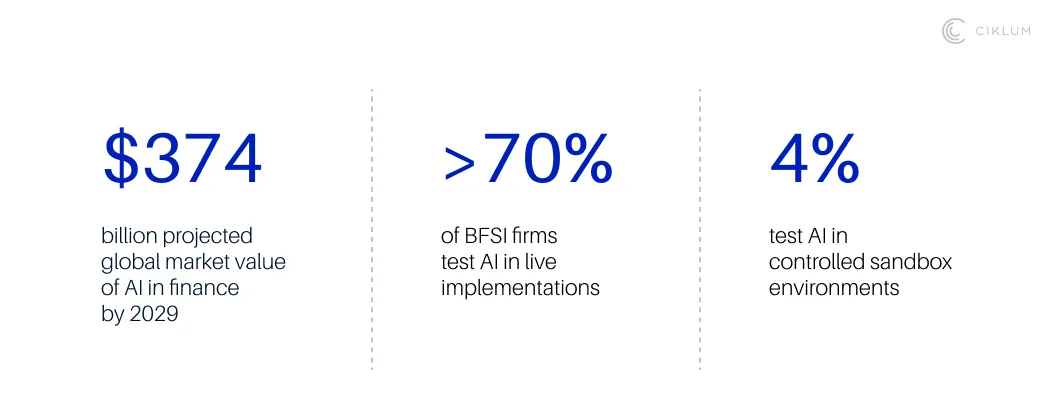
AI is taking on a larger role across financial services, banking, and insurance (BFSI). The global market value for AI in finance is set to reach $517.77 billion by 2030, as firms use the technology to improve customer service. Fraud detection and risk management are also driving investment.
Adoption, however, is outpacing preparation. Building AI-ready data infrastructure for financial services starts with reliable data and clear controls. Firms also need people who can use the technology safely in their day-to-day work. A survey found that more than 70% of organisations test or refine AI in live environments, while only 4% use controlled sandboxes. The gap is understandable. Large models are expensive to run, and realistic test environments can be difficult to recreate.
For UK banks and insurers, the message is straightforward: experimentation needs evidence and clear ownership. The FCA’s Supercharged Sandbox gives firms a controlled setting in which to test AI. The Financial Services AI Adoption Plan, developed by the government’s independent AI Champions, sets out recommendations for safe adoption. Firms will be in a stronger position when they can trace the data behind a model and explain how its outputs are used. Accountability must also be clear.
This guide explains how UK financial services organisations can assess AI readiness and modernise legacy systems. It also covers the commercial case and delivery plan.
What Does “AI-Ready” Look Like in Practice for Financial Services?
In the context of UK financial services, reliable AI implementation depends on four connected capabilities:
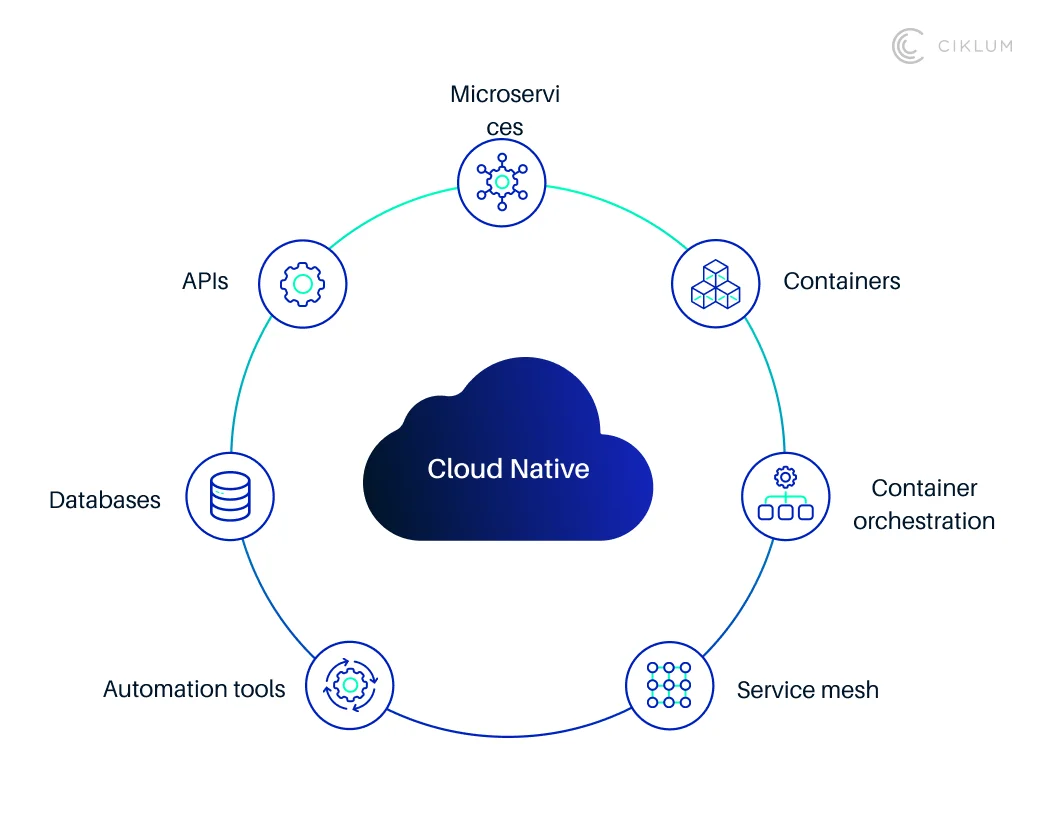
A Flexible Cloud-Native Architecture
Cloud-native architecture lets firms scale AI workloads as demand changes. Hybrid and multi-cloud designs can combine on-premises systems with cloud services while reducing dependence on a single provider.
Auto-scaling and usage-based billing help match spend to demand. FinOps controls should track cost by workload or use case so teams can identify inefficient models and infrastructure. For UK financial services firms, a cloud data platform must also preserve auditability, resilience, and access control
Data Governance for UK Financial Services: FCA and PRA Expectations
Good governance should make the data trail visible. Teams should be able to trace information from source to output and see who accessed it along the way. This supports UK GDPR accountability where personal data is involved. It also helps firms evidence Consumer Duty outcomes where retail customers are affected. Banks within scope of BCBS 239 also need reliable risk data aggregation and reporting.
Start with the decisions that carry the greatest customer or financial risk. Give each data set a clear owner and control who can access it. Record material changes as they happen. The result is evidence that compliance and risk teams can use, with controls that remain workable for delivery teams.
Integrating Legacy Banking Systems for AI
The rise of APIs means that legacy financial systems are becoming more and more integrated with modern data sources. Legacy core systems do not need to be replaced at once. Banks can use APIs to expose approved data from platforms such as Temenos, FIS or Finastra, then introduce new services in phases. Real-time streaming can support use cases that need current transaction data while core processing remains stable.
Data Mesh vs Data Fabric for Banking
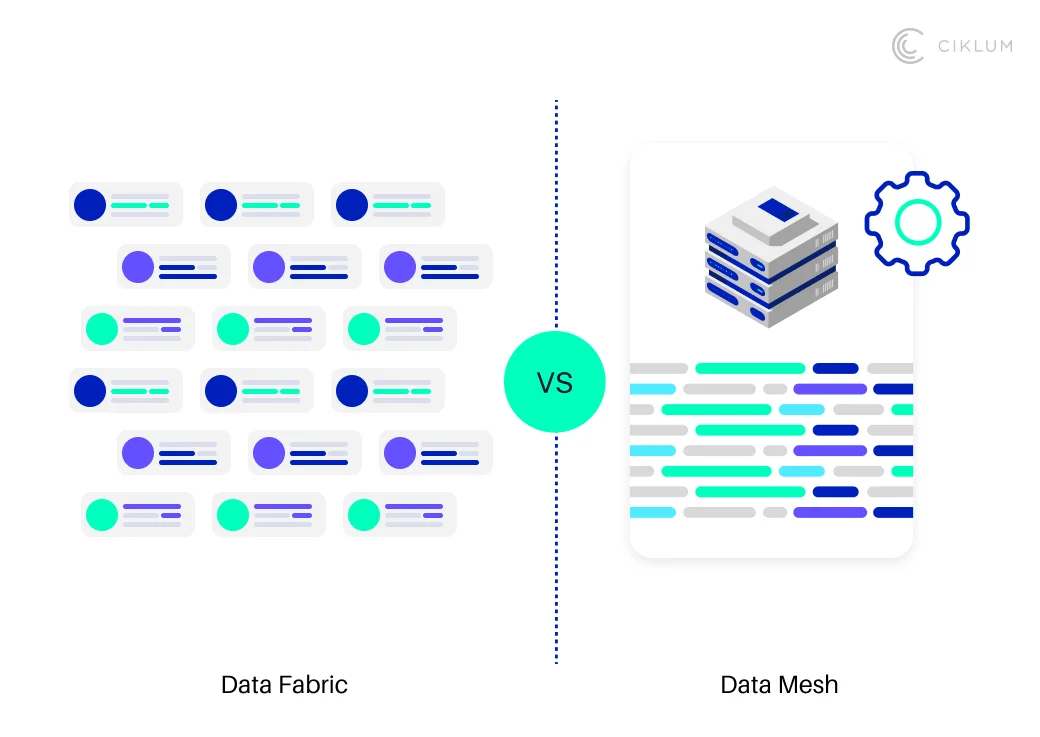
A good architectural approach can help financial services organisations strike the right balance between domain-specific expertise and enterprise-wide accessibility.
This can be achieved in two ways. A ‘data fabric’ brings data together in an operational layer and uses machine learning to process that data and uncover new insights. A ‘data mesh’, in contrast, decentralises data ownership and management to individual business domains. A fabric is generally the stronger choice where centralised compliance is the priority, often the case in tightly regulated UK financial services.
AI Readiness in Financial Services: A Four-Domain Self-Assessment
Assess the organisation against four domains before committing to a new platform or migration programme.
- Data & Infrastructure: Is your data centralised, accessible in real time, and available in a form AI models can use?
- Security & Governance: Is data lineage traceable and access auditable? Is there a single, accountable owner for data quality?
- Legal & Compliance: Can you retrieve the records needed to demonstrate compliance with the rules that apply to your firm? These may include relevant FCA SYSC provisions, Consumer Duty, and UK GDPR.
- Organisational Readiness: Do your teams have the in-house skills (data engineering, MLOps) to run AI in production, and is there executive sponsorship behind the transformation?
If the honest answer to most of these is ‘not yet’, that’s not unusual. It’s simply where the roadmap in this guide picks up.
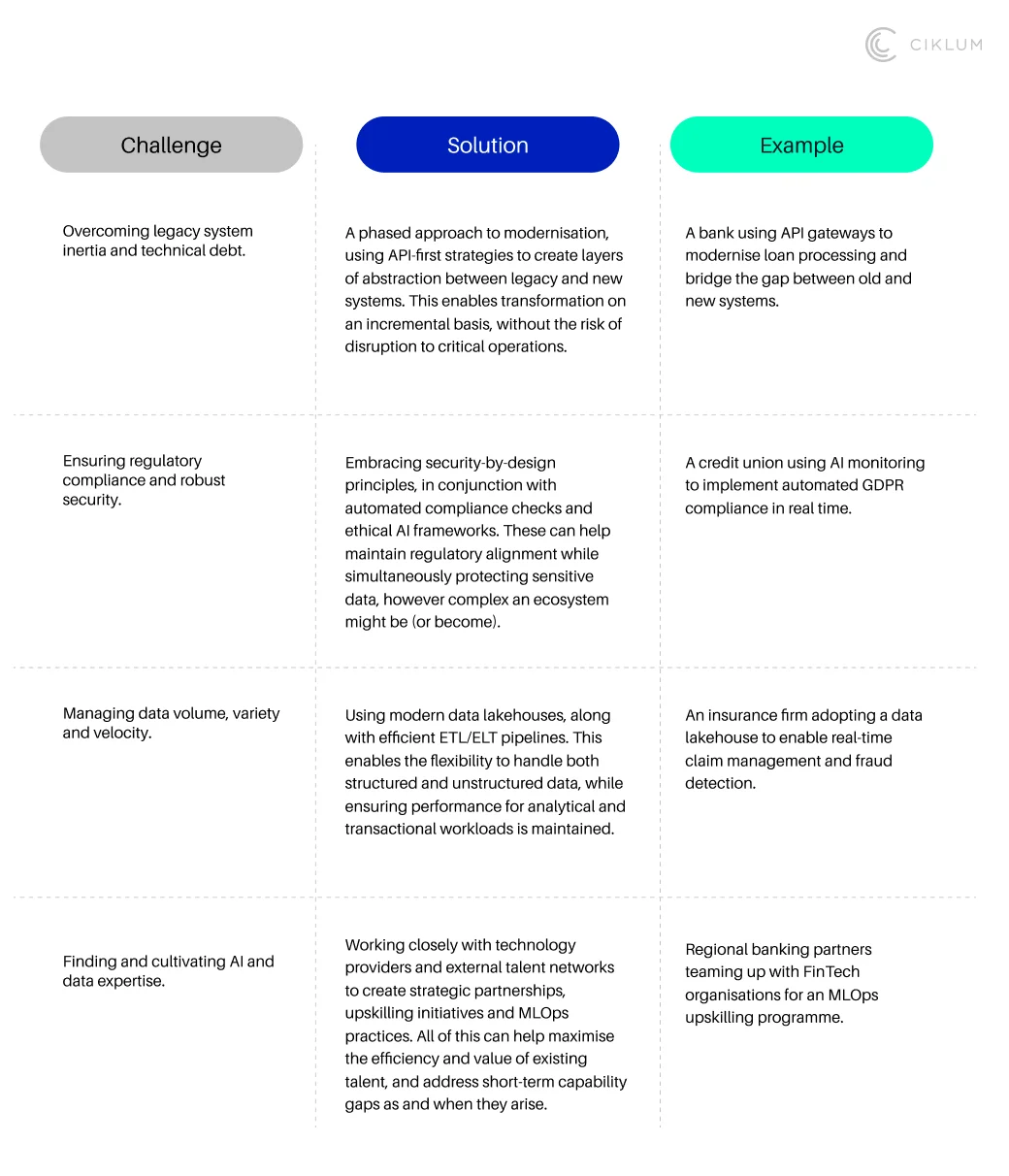
Solving Key Challenges in Financial Services Data Modernisation
Most programmes face four recurring challenges. The table below shows a practical response to each one.
AI-Ready Data Infrastructure: Cost and ROI
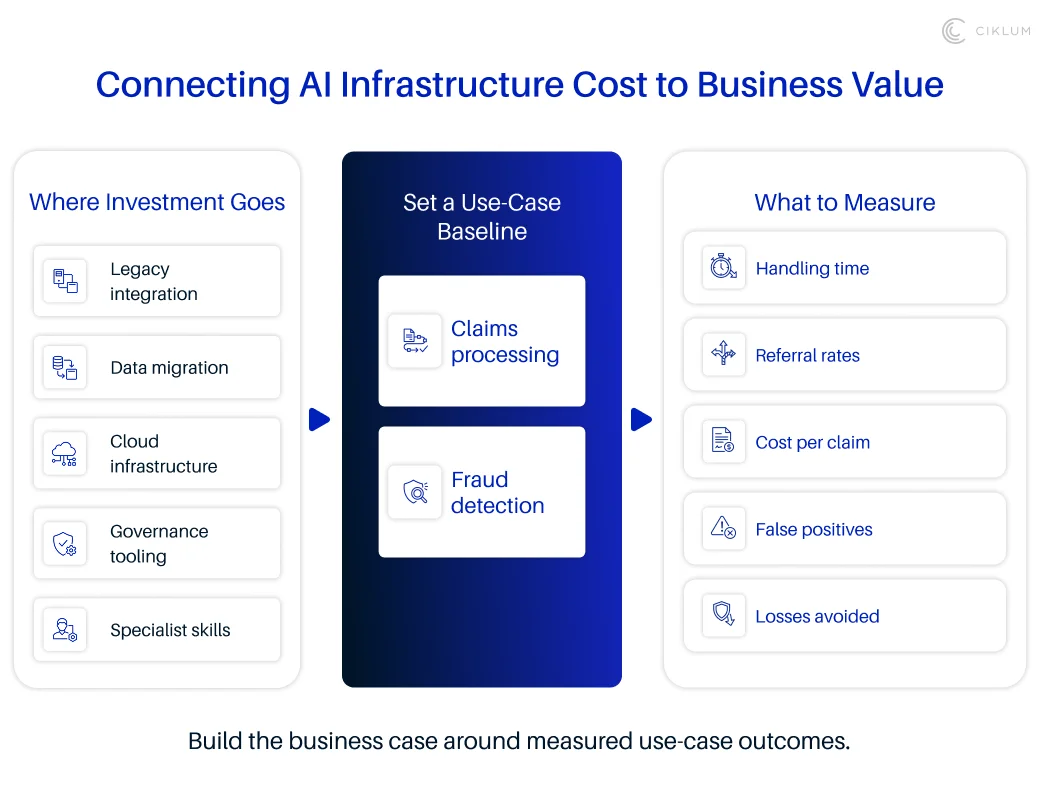
Cost is one of the first questions any leadership team asks. It's also one of the hardest to answer because there is no useful single price for an AI-readiness programme. Legacy integration and data migration often account for the highest initial costs. Ongoing spend comes from cloud infrastructure, governance tooling, and specialist skills.
Build the business case around one or two high-value use cases and a measured baseline. For claims processing, compare handling time, referral rates, and cost per claim before and after the change. Fraud programmes can track false positives and losses avoided. This gives leadership a firm basis for investment.
 How AI Is Changing Data Requirements in Financial Services]
Generative AI Raises the Bar for Data Quality
Generative AI depends on data that is relevant, current and well governed. Large volumes are less useful when the information is incomplete or outdated. Financial services firms therefore need clear controls over what data models can access and how that data is maintained.
Customers increasingly expect services that reflect their circumstances. Reliable data and real-time platforms can help firms tailor interactions beyond broad customer segments, provided the underlying information is accurate and used appropriately.
As AI takes on a larger role in customer interactions and operational decisions, firms need to understand what shaped each output. Explainability therefore needs to be considered from the start.
Explainable AI in Financial Services: Governance and Trust
Explainable AI helps teams identify the data and factors that influenced an output. An appropriate explanation depends on the model and the decision involved. It should also make sense to the person receiving it.
This supports internal review and clearer customer communication. In regulated use cases, it can also help firms retrieve the evidence needed for review. Governance should include validation and ongoing monitoring. A clear route for human challenge must remain.
Choosing an AI and Data Delivery Partner: Questions to Ask
Few financial services organisations will build all of this entirely in-house, and choosing the right delivery partner is as important as the architecture itself. Ask for evidence against the following criteria:
- UK regulatory experience supported by relevant project evidence.
- Legacy integration experience with core banking platforms such as Temenos, FIS or Finastra.
- A capability-transfer plan covering documentation, training, and MLOps handover.
- FinOps measures that connect cloud spend to workloads and business outcomes.
- Production evidence for converting unstructured data into governed, usable information.
- A nearshore delivery model with clear ownership, communication, and continuity controls.
Ciklum has a proven track record of working with banks, insurers, and payments businesses on data platforms, cloud modernisation, and AI delivery. Its financial services portfolio includes core banking integration, claims automation, and data engineering.
A Four-Step Roadmap to AI-Ready Data Infrastructure
An AI-ready data infrastructure is critical when AI’s influence in financial services will only continue to increase. This may sound like a complex endeavour, but it’s entirely achievable with the right strategy and expertise in place.
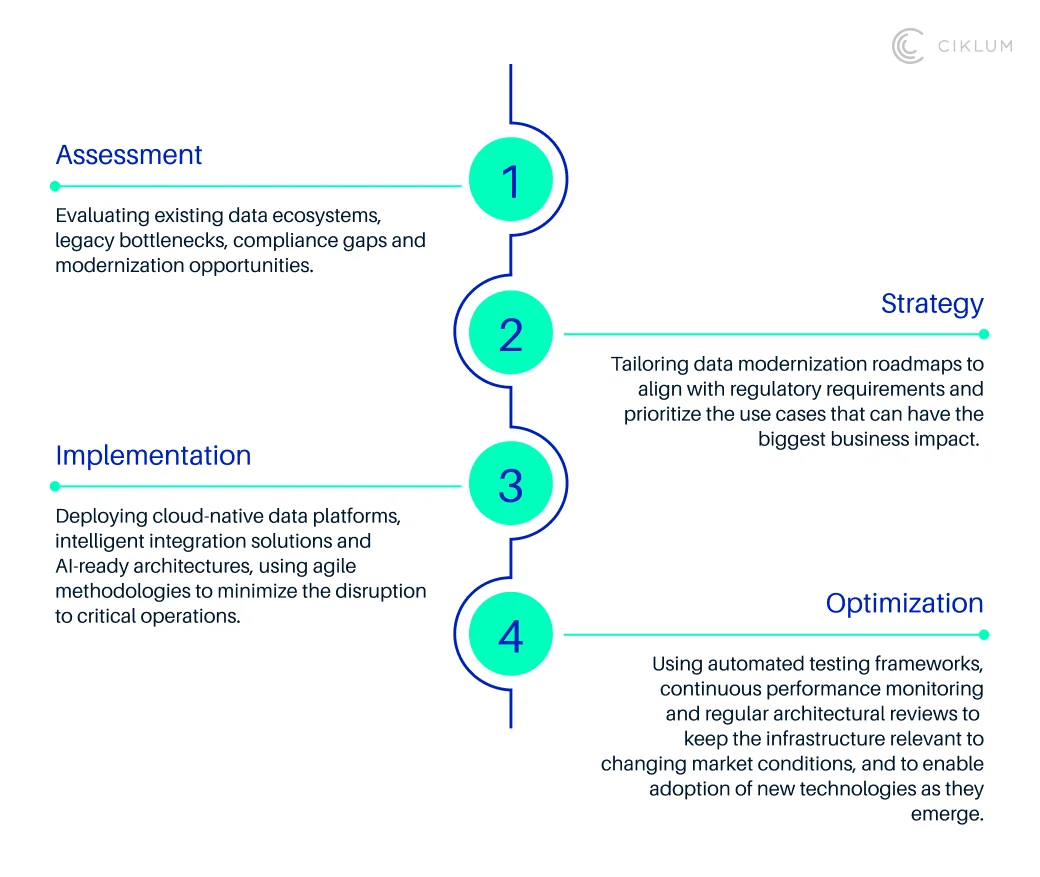
Our four-step approach covers every base:
To assess your data infrastructure and identify a practical first use case, contact our team. You can also read our AI automation guide.
Frequently Asked Questions
What does “AI-ready” actually mean in practice?
It means governed data, scalable infrastructure, and operating controls are ready for a defined AI use case. The four-domain assessment above shows where further preparation is required.
What UK regulatory requirements does AI data infrastructure need to satisfy?
Start with the use case because the applicable requirements depend on the firm and activity. UK GDPR and the Data Protection Act 2018 apply when personal data is processed. Relevant FCA systems-and-controls rules may shape governance and record-keeping. Consumer Duty also requires firms to monitor and evidence outcomes where retail customers are affected.
How do you integrate AI-ready infrastructure with legacy core banking systems like Temenos, FIS, or Finastra?
Use phased, API-first integration rather than a rip-and-replace to expose approved data from the core platform. This lets teams introduce new services while keeping critical processing stable.
Who owns AI data governance within a financial services organisation?
A named senior owner should be accountable for data quality and regulatory evidence. A cross-functional council can coordinate standards across technology, data, risk and compliance teams.
How long does an AI-readiness data transformation take?
Timelines depend on scope and system complexity. A focused assessment and roadmap may take several weeks, while implementation usually runs in phases over several months. Set milestones around the first production use case and the controls required to support it.
What should we ask when choosing an AI/data delivery partner?
Use the criteria above to compare regulatory experience, integration capability, and the proposed handover plan. Ask for evidence from comparable production work.

By Enver Cetin

Intelligent Automation Principal Lead
Enver specializes in Intelligent Automation and AI, leading transformative projects that enhance business efficiency. With expertise in Generative AI and digital management, he integrates cutting-edge AI solutions into business strategies. Enver holds advanced degrees in Business Consulting and Computer Science, driving Ciklum’s mission of industry innovation.
Blogs
Discover Similar Insights

How to Make Omnichannel Strategies Truly Improve Customer Experience
Learn More
Healthcare Digital Transformation Challenges: Why Programs Fall Short Post-Implementation
Learn More
Designing Scalable Software Architecture for High-Growth Products
Learn More
Understanding the True Impact of Technical Debt on Product Development Success
Learn More