



Key Takeaways
- Large organisations have adopted AI widely, but very few have turned that into measurable enterprise value.
- The AI readiness gap sits between using AI tools and rebuilding what's underneath them: workflows, data, governance.
- Five blockers explain most AI failures: Data, strategy depth, workflow inertia, governance, and skills.
- AI-mature enterprises start with outcomes, rather than tools.
Walk into almost any large organisation today, and you will find AI already in motion. Employees are using it to draft emails and summarise documents. Developers are using it to build pilots, and leaders are asking for use cases. Productivity stories are easy to find.
The harder question is whether any of this has changed how the business actually works and generates results.
McKinsey’s 2025 State of AI research captures the problem well. AI adoption is now widespread, with 88% of organisations using it in at least one business function. But only around 6% are turning that activity into a meaningful financial return.
Most organisations still have not embedded AI deeply enough into their workflows and processes to see material, enterprise-level benefit.
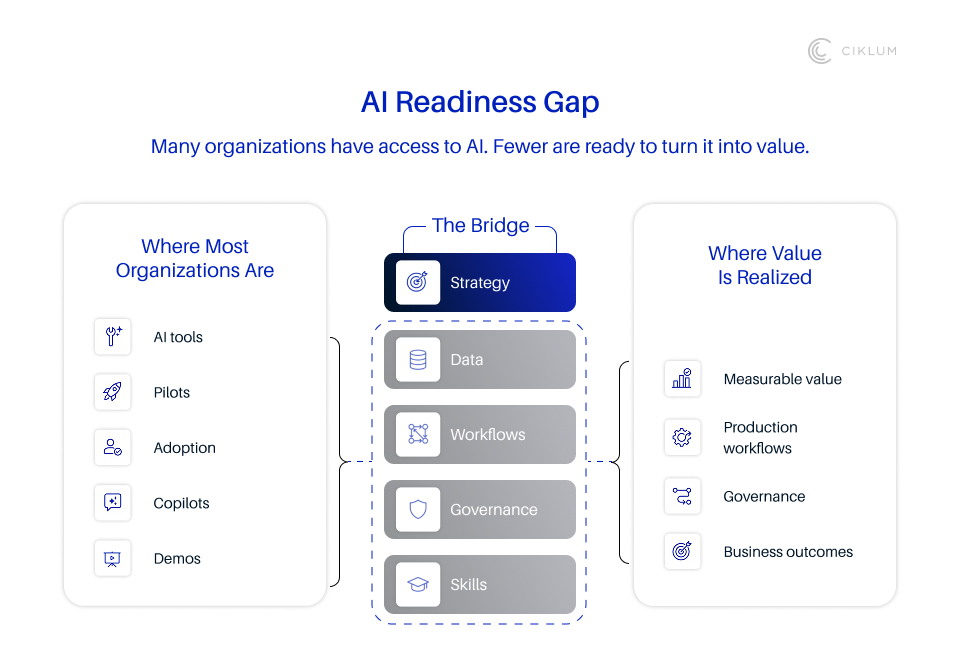
This is what we call the AI readiness gap. It’s the distance between using AI tools and turning them into measurable business value. It appears when adoption is high, but the strategy, data, workflows, governance, and skills needed to scale AI into production are still immature.
Executives are left with a more uncomfortable question. Is AI changing the economics of the business, or is it mostly adding another layer of activity?
Closing that gap starts with a clearer view of readiness: Which use cases matter, whether the data can support them, how governance will work, and what needs to change in the operating model before AI reaches production.
Being Busy Is Not the Same as Being Strategic
The AI readiness gap is the distance between having access to AI and turning that access into measurable value.
A large enterprise can have thousands of people using AI every week and still be strategically immature. Teams may be generating code, analysing documents, producing first drafts, and speeding up admin work. Useful activity, certainly. Strategic progress, not always.
So why is it important for AI to be strategic? It changes the system around the work. It changes which use cases get funded, how data gets prepared, how compliance is designed in, how teams measure value, and how workflows get rebuilt once machines can reason and act autonomously.
That is the difference between AI experimentation versus AI strategy. Experimentation proves what might be possible. Strategy decides what should be built and what needs to change around the technology for value to show up.
A 2026 UK survey from Sopra Steria found that 65% of senior leaders rated their organisation’s AI governance, infrastructure and strategy highly, against only 44% of mid-level and junior managers. The same research found similar gaps across strategy, governance, expertise, and culture.
That gap matters because managers sit closest to the friction. They see where data breaks down, where approvals slow progress, where workflows still depend on emails and spreadsheets, and where an impressive pilot starts to struggle once it meets real operating conditions.
AI maturity comes down to how deliberately AI is built into decisions, workflows, architecture, governance, and commercial priorities. Without that discipline, adoption keeps rising while business impact stays thin.
Five Blockers Standing Between Your Enterprise and AI Value
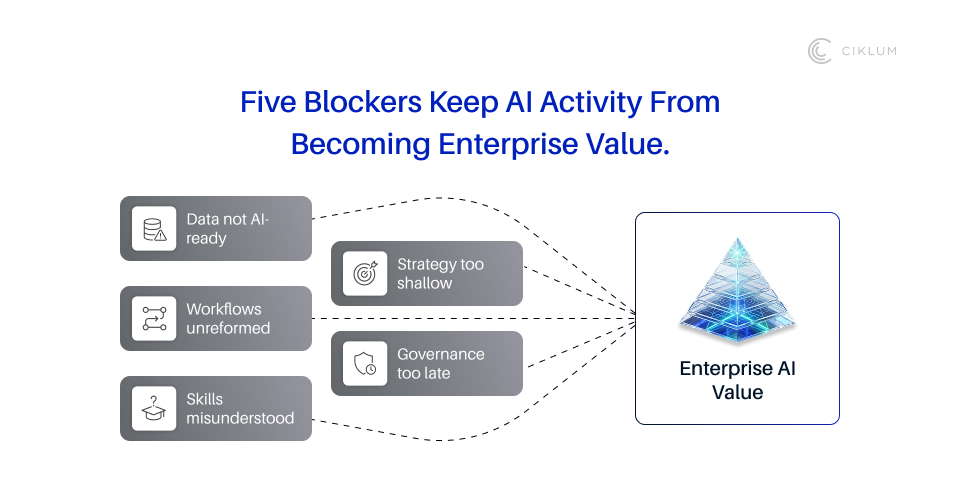
Most enterprises are dealing with five readiness gaps that reinforce each other, rather than a single AI problem.
Data is still not enterprise-ready
Data is usually the first blocker. AI systems need clean, governed, and accessible data to work well. Without AI-ready data, most organisations will struggle to move beyond the pilot stage. Deloitte’s 2026 report points to the same issue: many firms feel ready for AI on paper, but their infrastructure and data foundations are still catching up.
The stakes rise once AI moves into decision-making workflows. Agentic systems need context, permissions, lineage, and traceability to operate safely. Weak data creates weak judgement. The system may move quickly, produce confident outputs, and still send the business in the wrong direction.
We go into more detail on what AI data readiness actually requires in our piece on AI-ready data pipelines.
Strategy is too shallow
The second blocker is a strategy that sounds ambitious in a boardroom and disappears in execution. Plenty of companies feel strategically ready for AI, while the harder parts of readiness, such as infrastructure, data, risk, and talent, remain underdeveloped.
Too many firms still produce strategy decks that change nothing about capital allocation, product design, or operating responsibility. A serious AI strategy in 2026 acts as a prioritisation system. It decides which use cases deserve funding, which capabilities need to be built first, and which initiatives should stop before they absorb more time.
Unreformed workflows kill good models
The third blocker is workflow inertia. AI can make individual tasks faster, but real value only shows up when the workflow around those tasks changes too. That is why so many pilots look strong in isolation and then slow down in production.
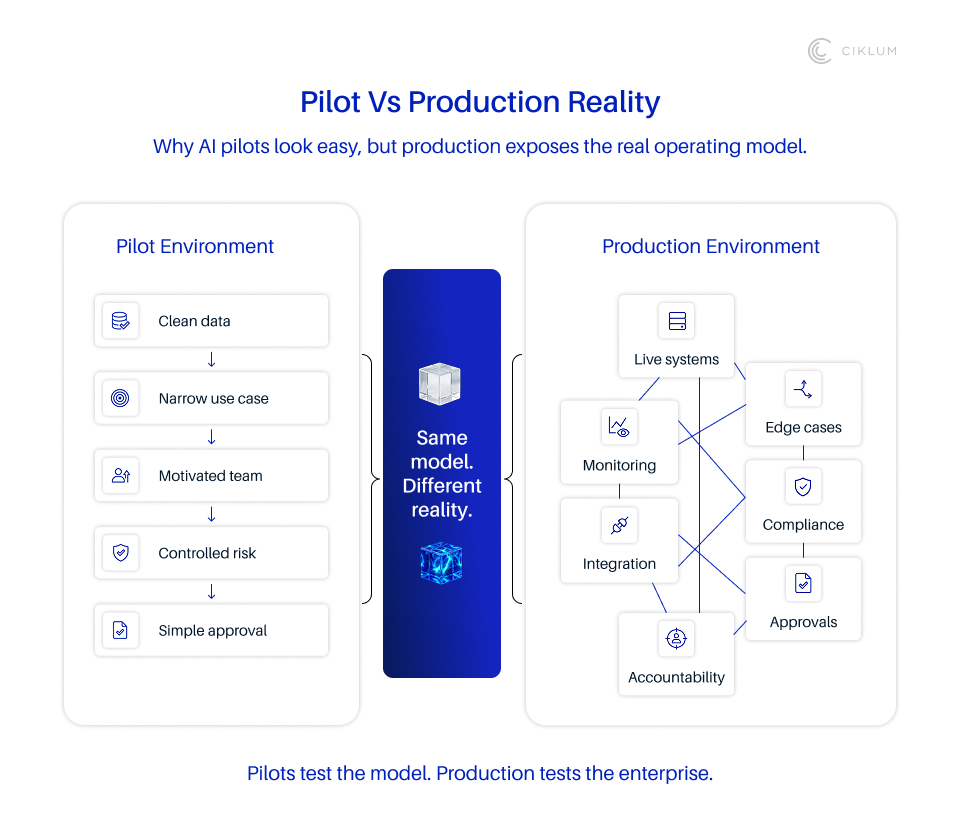
A pilot usually has clean data, a narrow use case, and a motivated team around it. Production is different. It has live systems, approvals, escalation paths, edge cases, and people who need to stay accountable for the outcome.
Without AI workflow integration, AI becomes another layer on top of the old process instead of a better way of working.
Governance is lagging behind agentic AI
In regulated UK sectors, AI governance cannot wait until the pilot is finished.
A demo is easy to approve when the system uses limited data, has limited users, and carries no real customer impact. But what happens when leadership asks: Who is accountable for the AI-assisted decision? What happens when the system is wrong or uncertain? Can the business keep operating if the AI system fails?
Regulation gives those questions sharper edges. The ICO’s guidance shows how UK GDPR applies when AI systems use personal data. The FCA’s operational resilience rules expect firms to understand how important business services could be affected if systems fail.
That is why enterprise AI governance needs accountability, data protection, human oversight, monitoring, audit trails, and resilience built in from day one. Leaving those decisions until the end usually turns governance into a blocker, just when the business expects scale.
The AI skills gap
The fifth blocker is the skills gap, although the 2026 lesson is more specific than “people need training.” DataCamp’s 2026 research found that 82% of enterprises offer AI training, yet 59% still report an AI skills gap. That suggests the real problem is not access to learning, but whether people can apply AI inside redesigned roles and workflows.
Teaching people how to prompt, summarise, or generate content only covers the surface. Roles need to be redesigned so teams know when to trust AI, when to challenge it, how to review its output, and how to stay accountable when AI becomes part of the workflow.
The Experimentation Trap
Most pilots never leave the room they were born in. The pilot survived a controlled environment, curated data, a motivated team, and zero exposure to the parts of the business that don't behave. But a production-grade AI is none of that. Production-grade AI involves messy data, live systems, approvals nobody remembers signing off on, and customers who expect the thing to work every time.
Deloitte's data shows that only around a quarter of organisations had pushed 40% or more of their pilots into production at the time of the survey. By 2026 standards, that looks like the default enterprise outcome.
The uncomfortable point is that many pilots reach this stage because the model has already done enough to prove the idea. The failure usually sits around the model: workflows that were never redesigned, data foundations that cannot hold up under live conditions, ownership that remains unclear, and governance that arrives too late.
Researchers at Stanford and BetterUp gave one version of this failure mode a name: “workslop.” It describes output polished enough to look complete, while still missing the judgment, context, or intent needed to move work forward. Progress becomes harder to question because it looks productive on the surface until someone downstream has to repair what the system created.
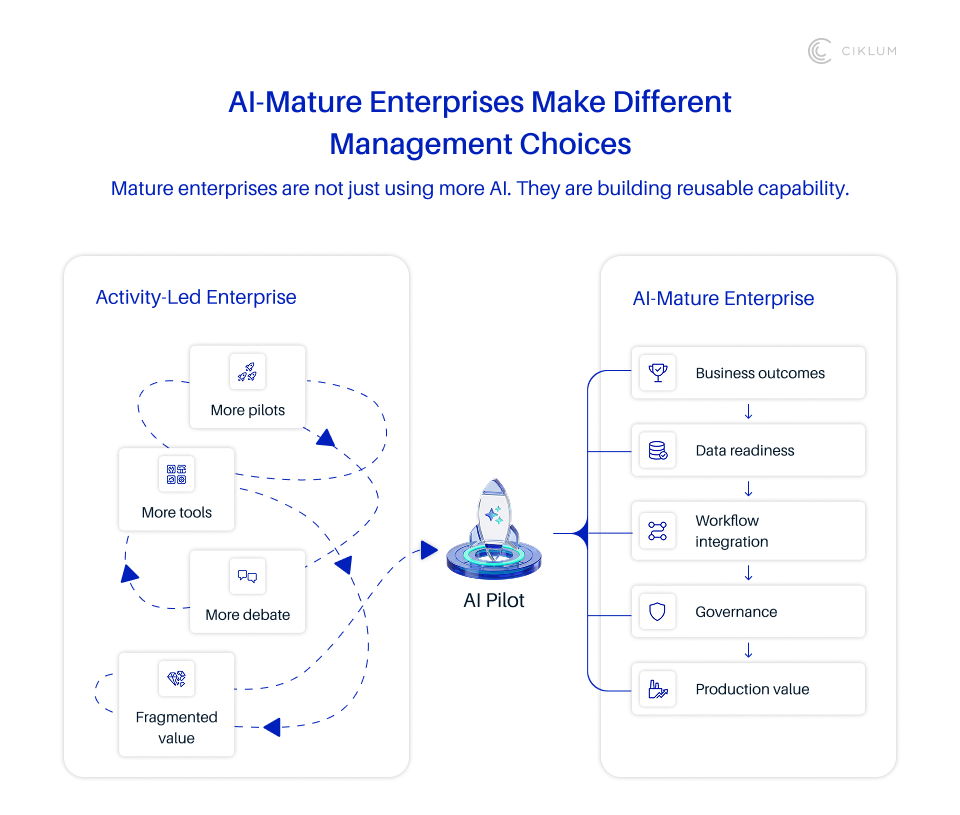
BCG’s data reinforces the point. Only around 5% of companies are genuinely AI-mature, and they're growing revenue at 1.7 times the rate of everyone else. Their advantage comes from discipline. They scale use cases that can hold up inside the real business, with rebuilt workflows, trusted data, clear ownership, and governance strong enough for production.
What AI-Mature Enterprises Actually Do Differently
The enterprises pulling ahead are making clearer management choices.
They define outcomes before tools
A weak initiative goes looking for a use case. A strong one starts with a P&L driver or a risk issue, then asks if AI is even the right way to fix it. That order matters more than people admit. Reverse it, and AI becomes the cart pulling the decision, instead of the engine inside one that's already been made.
In banking, that discipline tends to land on fraud resolution, KYC review, servicing productivity, or software delivery speed. These areas matter because they sit close to cost-to-serve, cycle time, or revenue, where impact is easier to measure and harder to inflate.
They treat data readiness as a pre-condition
Mature enterprises test data readiness before build starts. They want to know whether the data is clean, governed, accessible, and reliable enough to support the use case before a pilot becomes visible.
A serious AI transformation strategy treats data foundations as part of the value case, priced and resourced from day one, not a technical dependency someone is supposed to handle quietly in the background while the real work happens elsewhere.
Governance grows with the product
AI-mature enterprises build, expand, iterate, refine, and scale governance alongside the product itself. As the product matures, becomes more complex, and reaches more users, the governance around it needs to mature too.
Risk tiers, oversight rules, escalation paths, audit trails, and ownership become clearer as the use case moves closer to scale.
In regulated industries, this staged approach is critical. The more customer-facing, data-sensitive, or operationally important the AI system becomes, the stronger the governance model needs to be.
Closing the Gap with an AI Readiness Assessment
The most practical place to start is an honest AI readiness assessment, one that looks at strategy, data, governance, skills, and workflow design together, because these elements depend on each other. An organisation that isn’t clear on its top business outcomes shouldn’t be scaling more pilots. One with a weak data foundation shouldn’t be deploying more autonomous systems.
A sensible 12 to 18-month path starts with one or two high-value use cases, a production-grade data and governance baseline, and executive ownership. From there, the next step is building repeatable components, an approach we explore in more depth in our piece on compounding AI systems, so each new use case is easier and cheaper to deliver than the last. That is how organisations move from activity to strategy, and from strategy to value.
Conclusion: The Gap Is Not a Technology Problem
AI activity only becomes strategic when it changes how the business works.
The enterprises standing tall in 2026 are making that shift deliberately. They are rebuilding workflows, strengthening data readiness, scaling governance with product maturity, and redesigning work around human-agent collaboration before pressure forces the change.
Going beyond 2026, only those organisations will benefit that knew where AI actually mattered, built the foundations first, and scaled without losing control of what they built. Everyone has access to the same models now. What's scarce is the discipline to use them well.
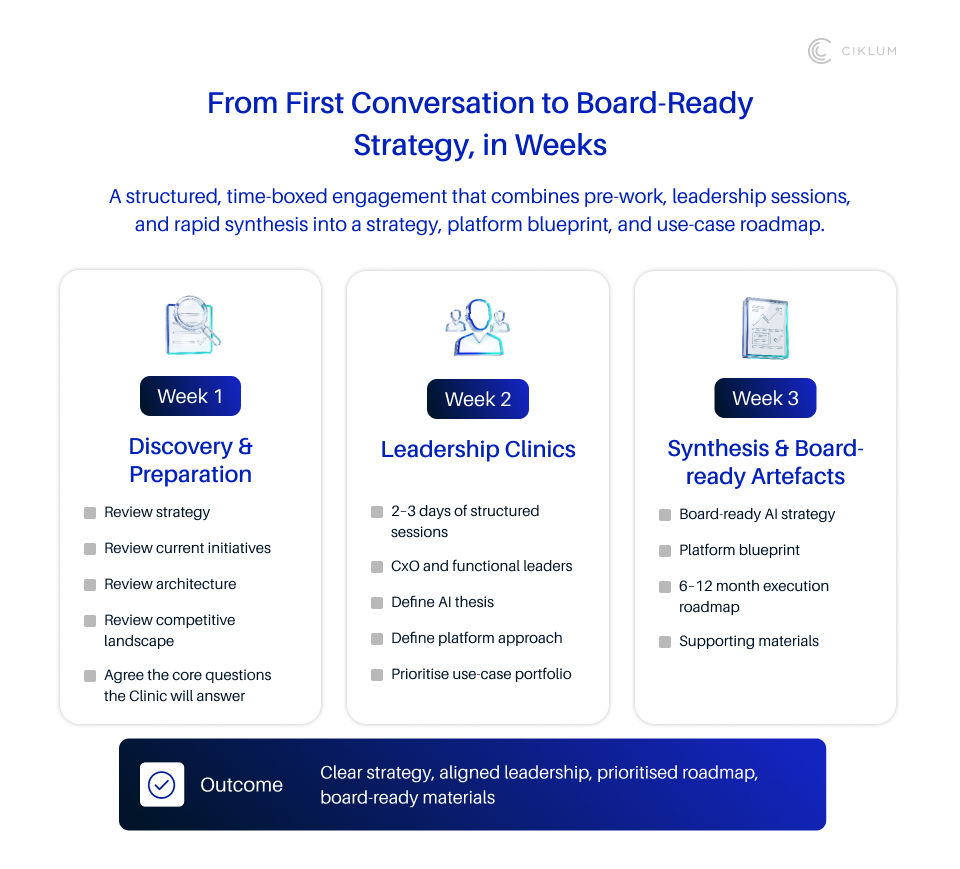
Ciklum's Enterprise-Ready AI approach starts there. Strategic clarity first, then AI systems engineered to survive the move from a controlled pilot to enterprise-scale production. If the goal is to separate AI activity from AI advantage, the AI Strategy Leadership Clinics are where that conversation should start.

By Yannique Hecht

Senior Director - AI R&D
13+ Exp
Yannique Hecht is the Senior Director of AI R&D at Ciklum, and a strategist with 13+ years of experience building at the intersection of product, AI, and strategy. He has led large, cross-functional teams and advised Fortune 500 companies on designing, building, and scaling next-generation digital products and AI-driven platforms.
Blogs
Discover Similar Insights

Designing Scalable Software Architecture for High-Growth Products
Learn More
Understanding the True Impact of Technical Debt on Product Development Success
Learn More
Why Software Teams Miss Deadlines and How to Build a Predictable Roadmap
Learn More
The Real Impact of AI Automation on Enterprise Productivity at Scale
Learn More