



- Key Takeaways
- The Gap Between Omnichannel Promise and Customer Reality
- What "Truly Omnichannel" Actually Requires
- Designing for the Seam
- The Data and Architecture Foundation
- Where AI Makes Omnichannel Better, and Where It Makes It Worse
- The Metrics That Actually Tell You It Is Working
- What Successful Omnichannel Operators Do Differently
- Conclusion
- Frequently Asked Questions
Key Takeaways
Customers do not think in channels, the business does: Shoppers move between social, web, app, store, support, and email inside a single intent without noticing the technology underneath. The omnichannel programs that actually improve customer experience are the ones built around the customer's journey rather than the company's org chart.
Omnichannel fails at the seams, not inside the channels: Most touchpoints work fine in isolation. The damage happens at the handoff, when context, identity, history, and intent fail to travel with the customer. Roughly nine in ten customers say they have to re-explain themselves when they switch channels, and the abandonment rate climbs sharply when they do.
Unified commerce is the operating system, not the slogan: True omnichannel requires four connected foundations: one customer identity, one customer profile, one inventory truth, and one orchestration layer. Without those, every channel investment is an expensive way to make the seams more visible.
AI raises the bar on omnichannel, it does not replace it: Agentic commerce, conversational interfaces, and AI-driven personalization all assume the data and identity layer underneath is clean and shared. AI deployed on top of a fragmented stack amplifies the fragmentation. AI deployed on a unified stack compounds the value of every prior touchpoint.
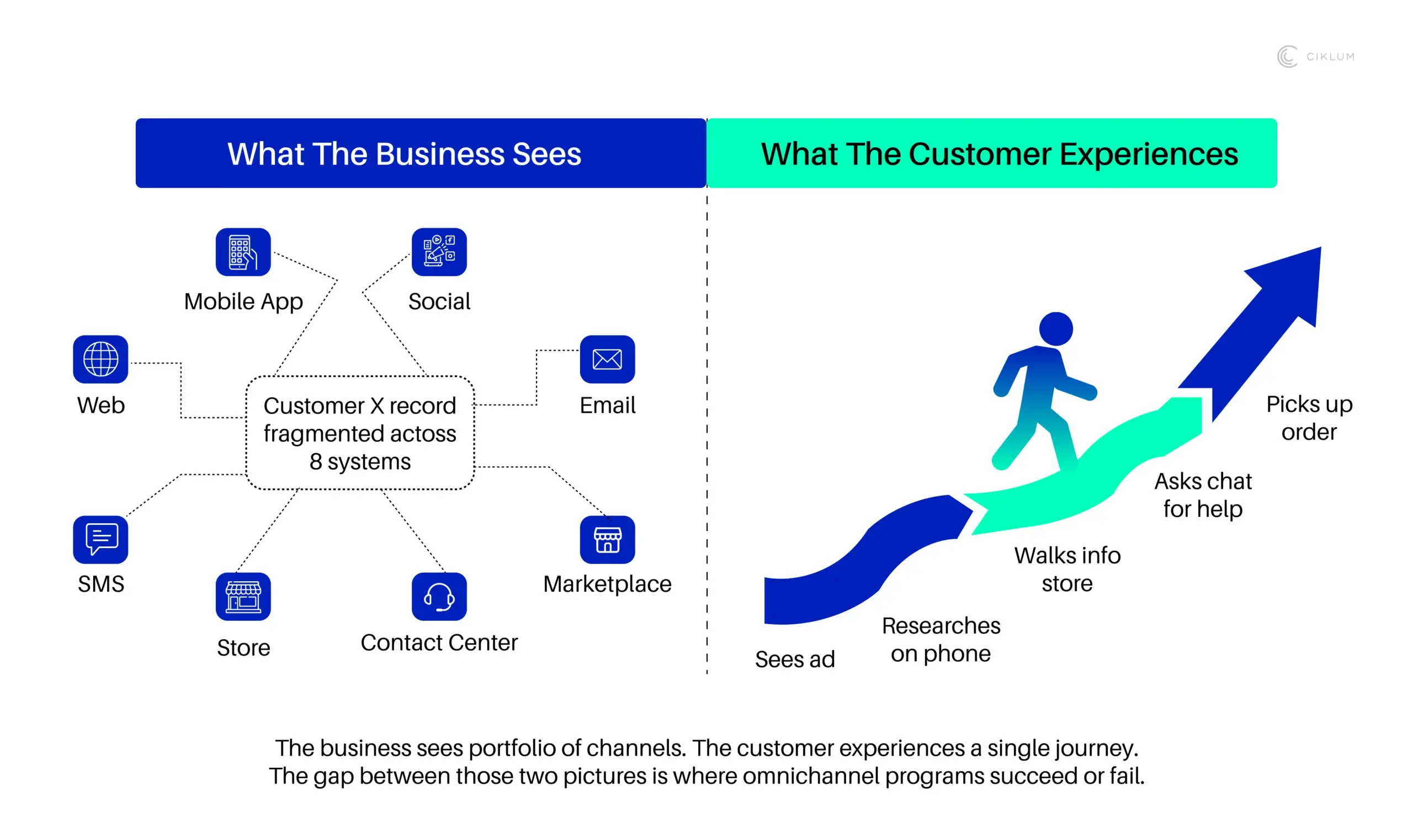
The omnichannel paradox in 2026 is that almost every consumer-facing brand has invested in it, almost every customer expects it, and most still do not experience it. The technology stacks behind the scenes have multiplied. The customer journeys on top of them have not become noticeably more coherent. The gap between what the boardroom calls "our omnichannel strategy" and what the shopper actually feels at the point of friction is wider than the budget would suggest. This article looks at why that gap persists, what the organizations closing it are doing differently, and how to build an omnichannel program that improves customer experience in a way that shows up in retention, conversion, and lifetime value rather than only in a marketing slide.
The Gap Between Omnichannel Promise and Customer Reality
The most useful starting point is the data on what customers actually experience inside the journeys brands describe as seamless. Forrester's Customer Experience Index, 2025 found that U.S. and Canada consumer perceptions of CX quality have dropped for a fourth consecutive year and now sit at a new all-time low, with 25% of evaluated brands posting statistically significant declines and only 7% improving. The shape of the decline is consistent across industries and across the three dimensions Forrester tracks: effectiveness, ease, and emotion. The single thread underneath it is a widening gap between the experience brands intend to deliver and the experience customers actually feel, often at the points where channels and systems hand off to each other.
Modern customers do not run their journeys through a single channel. They start on social media, continue on mobile web, ask a question in chat, walk into a store, escalate to a human, and check back through an app, often inside a single buying decision. The journey crosses systems that were originally designed to be operated by different teams, and the customer experiences every crossing as a moment that either preserves their context or resets it. The 2026 wave of Deloitte's Global Retail Industry Outlook, drawn from a survey of 330 retail executives worldwide, frames the same point from the retailer's side: 67% of executives expect AI-driven personalization capabilities to be in place within the next year and 68% expect agentic AI adoption inside two years, and the constraint they cite most often is not the AI itself but the unified data and operating model underneath it.
Notice what is and is not in those numbers. The customers are not asking for more channels. They are asking for the channels that already exist to carry their identity, history, and intent without restarting. The failure mode in 2026 is not coverage. Almost every relevant channel is covered. The failure mode is coherence. The handoffs between channels behave like resets instead of continuations, and the customer feels the reset every single time.
This is why omnichannel programs that are measured channel-by-channel can look healthy on internal dashboards while the customer experience is quietly eroding. Each individual channel hits its conversion or resolution targets. The seams between channels (the places where the customer physically crosses from one system to the next) are where the value leaks. When the e-commerce platform does not know what the customer just bought in store, when the support chat does not know what the customer just emailed about, when the loyalty program does not see the in-app browse session, the customer experiences the brand as a collection of departments rather than a single entity. They leave for the competitor who feels like one entity.
What "Truly Omnichannel" Actually Requires
The vocabulary has shifted in the last two years for exactly this reason. The industry has moved from "omnichannel," which describes the customer-facing surface, to "unified commerce," which describes what has to be true underneath the surface to make omnichannel work. The 2026 Gartner Magic Quadrant for Customer Data Platforms marks a structural moment in this shift. The market is bifurcating into platformization, where the CDP is the foundational layer of a broader connected application ecosystem, and agentification, where the CDP is a lean, AI-agent-native engine that orchestrates execution across channels. Both directions assume the same thing the previous decade assumed about omnichannel and rarely delivered: one unified customer context that every channel can read from and write back to.
Translated out of analyst vocabulary, a truly omnichannel program requires four connected foundations.
The first is one customer identity. Whether the customer is anonymous on the mobile web, logged in on the app, paying with a tokenized card in store, or asking a question in chat, the brand needs a reliable way to resolve those touchpoints to a single individual without forcing the customer to do the resolution work. That is identity resolution, and it is the layer most omnichannel programs underinvest in because the work is tedious and the ROI shows up indirectly in every downstream metric.
The second is one customer profile. Once the identity is resolved, every channel needs to read the same record of who the customer is, what they have bought, what they have asked about, what they own, what they prefer, what they consented to, and what state their journey is in. The customer data platform exists to be that record. The CDP only works if every channel is wired to read from and write to it in real time, which is the part most programs skip.
The third is one inventory truth. Especially in retail, the single most common omnichannel failure is the system promising what the store cannot deliver. Same-day availability is now a baseline expectation, and the abandonment rate climbs sharply when it is not honored. Click-and-collect, ship-from-store, and buy-online-pickup-in-store programs depend on inventory data that is genuinely real time and accurate at the item level, but the gap between what the e-commerce system shows and what the store shelf actually holds remains the most common operational source of broken customer trust. Ciklum's work on TUI Group's One Payment Platform, which consolidated a fragmented set of source-market payment and acquirer ecosystems into a single, governed engine across more than 20 million customers and 100-plus destinations, is a useful illustration of the same principle outside retail. The underlying lesson is the same in both: customer experience downstream is only as good as the operational source of truth upstream. Inventory truth is the operational backbone of customer experience.
The fourth is one orchestration layer. Even with identity, profile, and inventory unified, the brand still has to decide in real time which next action to take, on which channel, with what content, at what cadence, under which constraint. That is the orchestration job, and it is where the agentic CDP architectures Gartner now treats as a distinct market category are pointing. Whether the orchestration runs as classic journey logic or as autonomous AI agents pursuing outcomes, the requirement is the same: a single decisioning surface that operates on the unified data underneath.
When those four foundations are in place, "omnichannel" stops being a strategy slide and becomes the way the system behaves by default. When any one of them is missing, the program reverts to the experience the customer already knows.

Designing for the Seam
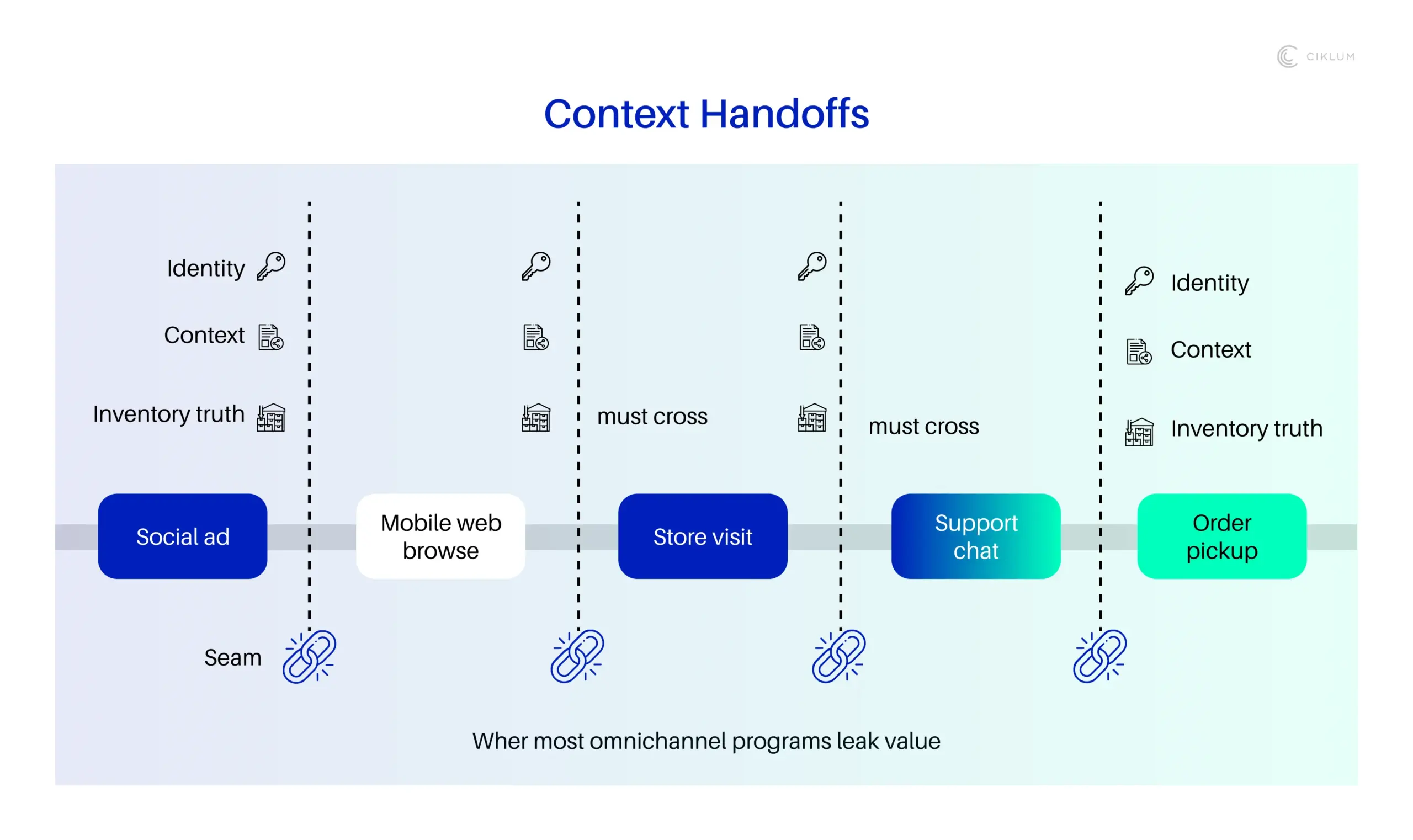
Once the four foundations are in place, the work shifts to the seams. The seam is the point where the customer physically crosses from one channel or system to another. It is the moment from app to store, from chat to call, from anonymous browse to logged-in checkout, from email click to mobile push, from web cart to in-store register. Every seam is a chance for context to travel or to break. Every broken seam is a chance for the customer to leave.
The discipline that distinguishes mature omnichannel programs from immature ones is designing for the seam, not for the channel. Three patterns matter most.
The first is context persistence. The moment the customer crosses a seam, the next channel needs to know what just happened. The support chat needs the email thread. The store associate needs the abandoned online basket. The push notification needs the page the customer just left. The mechanism is usually a real-time event bus carrying context to whatever channel the customer surfaces in next, but the engineering decision matters less than the operating commitment: nothing the customer told the brand on the previous channel needs to be told again on the next one.
The second is identity continuity across the anonymous-to-known transition. Most digital customer journeys start anonymous and become known at some point downstream. The systems on each side of that transition are usually different. The anonymous browsing history, the cart, the wish list, the abandoned checkout, and the loyalty program all need to stitch together at the moment of identification without losing anything. Identity resolution platforms have matured to the point where this is achievable, but only when the brand has decided that the stitching is a priority worth designing for.
The third is conversational continuity across human and AI touchpoints. The 2026 contact center mix is now almost universally hybrid: an AI agent handles the first attempt, a human takes over on complex cases, and the customer should not feel the handoff. The summary the AI generated needs to flow to the human, the human's resolution needs to flow back into the customer record, and the next time the customer arrives on any channel the brand should know what happened. The published guidance on omnichannel CX continuity is now unanimous on this point: AI deployed inside individual channels without shared context across them creates the appearance of automation while quietly increasing customer effort.
The Data and Architecture Foundation
The technology question that shows up in every omnichannel program is whether to invest in a customer data platform, and what shape it should take. A CDP, in some form, is now the de facto foundation of any serious omnichannel architecture, and the Gartner Magic Quadrant referenced earlier has formalized the two architectural paths the market has split into.
The platformization path treats the CDP as a foundational layer inside a larger connected application ecosystem, with marketing, service, commerce, and increasingly ERP and supply chain reading and writing to the same unified customer record. The promise is enterprise-wide consistency: a decision made in marketing flows through to service and operations without brittle integration. The cost is a heavier commitment to a single vendor ecosystem.
The agentification path treats the CDP as a lean, warehouse-native engine designed to be operated by autonomous AI agents that handle journey orchestration and cross-channel optimization. The promise is composability and speed: the brand keeps its data warehouse, plugs in specialized agents for execution, and avoids the cost and lock-in of a full enterprise suite. The cost is operational maturity. Autonomous agents on top of a CDP only work when the data underneath them is genuinely unified and the governance around their decisions is in place.
Either path requires the same prerequisites: clean identity resolution, real-time event streaming, governance over consent and privacy, and the discipline to keep the customer record as the source of truth across every channel. Composable commerce architectures (an API-first, cloud-native, modular approach where each capability can be swapped without rebuilding the whole stack) have become the default reference architecture for retailers and consumer brands building toward this, because the alternative (a monolithic platform doing every job adequately and no job well) cannot keep up with the rate at which channels are appearing and changing. Ciklum's data and analytics engineering practice works with brands on exactly this layer, from CDP implementation and identity resolution to the event-streaming backbone that everything downstream depends on.
Ciklum's work with Salling Group, Denmark's largest retailer, is a useful illustration of what this foundation looks like in production. The engagement spans data platform engineering, machine learning, and digital product delivery across the group's multi-format retail operations, with the goal of unifying customer, transaction, and inventory data into a single layer that the loyalty program, e-commerce, and store operations can all draw from. The benefit shows up not in any single channel metric but in the coherence the customer experiences as they move between the chain's grocery, discount, and department-store brands.
Where AI Makes Omnichannel Better, and Where It Makes It Worse
The 2026 AI conversation overlaps with the omnichannel conversation in a way that creates both opportunity and risk. AI is becoming the orchestration and personalization layer that omnichannel programs have wanted for two decades and could not previously afford to operate. The risk is also that AI deployed on a fragmented data stack makes the fragmentation worse, not better.
Agentic commerce, which McKinsey forecasts could mediate $3 trillion to $5 trillion of global consumer commerce by 2030, is reshaping where intent forms and where transactions complete. AI shopping agents are already discovering, comparing, and increasingly transacting on behalf of consumers. Brands that present themselves coherently to both human shoppers and machine intermediaries (with consistent product data, attribute structure, pricing, availability, and proof) win the early shelf placement in the agent's recommendation. Brands that present differently across channels lose it.
Inside the brand's own surface, AI is becoming the conversational layer customers expect. Conversational AI handles the first attempt at a service request, generative AI personalizes the homepage and the search results, AI-driven recommendation systems run the merchandising decisions that used to require a manual planning cycle. When those systems share context across channels, the customer experiences a brand that knows them. When they do not, the customer experiences a brand that has bolted intelligence onto each channel separately and produced a more elaborate version of the same fragmented journey. This is the engineering reality behind Ciklum's AI agents and autonomous orchestration practice, which is built around the assumption that agents only earn their keep when they operate on top of a unified customer record rather than alongside one.
When AI operates inside individual channels without shared context, it may give the illusion of automation but actually increases customer effort. The customer asks a question in website chat, escalates to the call center and gets a different answer, opens the app and sees a different offer, walks into the store and has to repeat everything all over again. Each AI in each channel might perform well on its own, but the overall journey for the customer is still fragmented. The solution isn’t to reduce AI—it’s to build a unified profile, identity, and event-streaming foundation that every channel and AI layer can share, so the AI sits on top of a single source of customer truth rather than operating in silos.
Here’s what this shift means in practice: technology investments that actually make things better for the customer are the ones that allow context and information to flow seamlessly between different systems and channels. When that context isn’t shared, those projects tend to be abandoned in less than two years because customer effort rises and the business sees no real benefit. Building a unified data foundation isn’t just a nice-to-have - it’s the essential first step to delivering connected, effective customer experiences.
The Metrics That Actually Tell You It Is Working
One of the more reliable signs that an omnichannel program is in trouble is that the only metrics reported on it are channel-by-channel. Web conversion, app conversion, store conversion, NPS by touchpoint. Each one can look healthy while the journey across them is bleeding. The metrics that actually tell the truth about omnichannel performance are the ones measured at the seam, not inside the channel.
Repeat contact rate tells you how often customers have to return with the same problem across multiple channels. If you notice this number going up, it’s a sign that important information isn’t getting passed along as people move between channels. Customer effort score at the handoff reflects how difficult it was for someone to switch from one channel to another, making it one of the best ways to spot pain points right at the seams between systems. Cross-channel resolution rate looks at how many customer journeys are wrapped up in the same channel they started, and how many require a handoff or escalation; with a strong program, you’ll see fewer unnecessary switches as time goes on. Journey completion rate tracks what percentage of people finish what they set out to do without giving up. For omnichannel experiences, this is often more telling than any single channel’s conversion rate, because it shows the real impact of all those transitions and handoffs along the way.
For retail specifically, the BOPIS and ship-from-store metrics are the canary. Same-day availability is now the customer's baseline expectation, and the abandonment rate climbs sharply when same-day cannot be honored. Inventory accuracy, BOPIS fulfillment rate, and time-to-pickup are the metrics that distinguish the retailer the customer trusts to bridge online and store from the retailer they no longer trust enough to risk the trip.
Another important perspective comes from looking at shopper behavior. Most buyers today move fluidly between online and in-store shopping - webrooming (researching online and purchasing in store) and showrooming (researching in store and buying online) have become the norm across nearly all retail categories. As a result, most purchase journeys now cross at least two channels, and each transition represents a moment where customers can either gain confidence or run into roadblocks. Retailers see the same reality from their side: physical and digital touchpoints are tightly connected in how customers make decisions. The brands that outperform aren’t just tracking conversions at the end - they focus on creating smooth transitions at those crossing points where customers move between channels.
What Successful Omnichannel Operators Do Differently
The retailers and brands that have closed the omnichannel gap in 2026 are not the ones with the most channels or the largest CX budgets. They share a recognizable set of operating habits.
They own the journey, not the channel. There is a single accountable owner for the end-to-end customer experience, and the org chart is structured so that the seams between channels are someone's explicit responsibility rather than the residual of three departments pointing at each other. The internal redesign usually precedes any meaningful external change.
They invest in identity and data unification before they invest in personalization. The temptation is always to launch the visible feature first (the recommendation engine, the loyalty program, the conversational agent) and to defer the foundational work. The brands that come through the 2026 omnichannel transition fastest do the opposite: they spend the first year on identity resolution, the CDP, and the event-streaming backbone, and only then turn on the personalization and AI layers that depend on it. The visible features ship later. They also ship better, because the data underneath is real.
They make inventory truth a customer experience metric, not just an operations metric. The decision to promise same-day BOPIS, ship-from-store, or in-store availability is treated as a customer trust commitment, and the inventory accuracy required to honor it is treated as a precondition for making the promise at all. The retailers running this discipline cite materially higher BOPIS conversion and lower abandonment.
They treat AI as a layer on top of unified data, not as a substitute for it. Conversational AI, agentic commerce readiness, and personalization engines are sequenced after the identity, profile, and orchestration foundations are in place. The deployment that goes into production first is the one with the cleanest data behind it, not the one with the most ambitious model.
The CX scorecard reports repeat contact rate, cross-channel resolution rate, effort score at handoffs, journey completion rate, and the BOPIS funnel metrics alongside the channel-level conversion numbers. The seam metrics are the ones that move first when the program is improving or eroding, and the leadership team treats them as the leading indicator. Ciklum's generative AI and decision science teams work with retailers on exactly this layer, because the move from disconnected channels to unified commerce is a data and decisioning problem before it is anything else.
Conclusion
True omnichannel success reveals itself not in grand announcements, but in the effortless consistency customers encounter throughout their journeys. Customers no longer have to repeat themselves at channel boundaries. Conversations that began on Instagram move seamlessly to the contact center without interruption. Baskets left behind on mobile are instantly visible to store associates when shoppers arrive in person. Loyalty offers follow the customer automatically, without prompting. What once were friction points like webrooming and showrooming - transform into opportunities for conversion. The BOPIS promise is reliably fulfilled. Customer-effort scores at transitions steadily decline and remain low. As a result, repeat customers become a larger share of revenue, because the experience consistently gives them reasons to return.
The hardest part of getting there is not the technology. It is the decision to spend the first year on the foundations of identity, data, inventory, and orchestration before the second year on the visible features that depend on them. The organizations doing that work in 2026 are building the omnichannel programs that will still be working in 2030. The ones still investing in channels without investing in the seams between them are buying more elaborate versions of the same fragmented journey their customers already know.
If those patterns match what you are seeing in your own customer-effort and channel-switching numbers, the next step is usually not another channel investment. It is a deliberate look at identity, data, inventory, and orchestration as a connected system. Ciklum's product engineering teams, alongside our retail, data, and AI practices, work with operators through exactly this transition, from auditing the current omnichannel architecture to standing up the unified commerce foundation that turns disconnected channels into a single customer experience.
Frequently Asked Questions
1. What is the difference between omnichannel and unified commerce, and does it matter?
Omnichannel is about presenting a consistent customer-facing experience across every channel. Unified commerce is what enables this underneath: one customer identity, profile, inventory, and orchestration layer for all channels. The difference matters: many "omnichannel" efforts are just rebranded multichannel programs, and customers feel the gaps at every transition. Unified commerce provides the real engineering needed to truly deliver omnichannel experiences.
2. Where does AI fit into omnichannel, and where does it create new problems?
AI works best when built on top of unified data and identity: personalizing, orchestrating, and interacting smoothly across channels. When AI runs on fragmented data, it amplifies silos: each channel's AI works in isolation, raising customer effort. Watch for "AI in every channel" instead of "AI on unified customer data." The first adds friction; the second builds value by connecting every touchpoint.
3. Is BOPIS still worth investing in with 2026’s delivery dynamics?
Yes: probably now more than ever. As delivery costs rise, BOPIS has become a go-to for customers wanting speed without fees. The market is expected to double over the next decade. But the model only works if inventory accuracy is high enough to honor same-day promises. Below 95% accuracy, abandonment rises sharply, and missed promises erode customer trust.
4. Which metrics should an omnichannel program actually report on?
Stop reporting only channel-level metrics. Add seam-level metrics: repeat contact rate, customer effort score at handoffs, cross-channel resolution rate, and journey completion rate. For retail, add inventory accuracy, BOPIS fulfillment rate, and time-to-pickup. These are the numbers that move first when the program is improving or eroding, and they capture the parts of the customer experience that the channel dashboards systematically hide.

By Ciklum Editorial Team

Ciklum’s Editorial Board is a collective of experienced writers and industry experts, bringing together perspectives shaped by real-world engineering and delivery experience. Through collaborative insights, the team explores how technology, AI, and digital innovation move from concept to execution across industries.
Blogs
Discover Similar Insights

Healthcare Digital Transformation Challenges: Why Programs Fall Short Post-Implementation
Learn More
AI-Ready Data Infrastructure for Financial Services: A Practical Guide for UK Banks and Insurers
Learn More
Designing Scalable Software Architecture for High-Growth Products
Learn More
Understanding the True Impact of Technical Debt on Product Development Success
Learn More