
Key Takeaways
Retail runs on thin margins, so the drains matter more than the wins: In a business operating on two to five percent net margin, the technology quietly bleeding cost every month does more damage than any single underperforming feature. The retail technology impact on margins is decided as much by what is leaking as by what is invested.
The biggest drains are invisible on the roadmap: Fragmented systems, legacy run cost, duplicated manual work, and shelfware do not show up as line items called "margin loss." They hide inside the integration tax, the overnight data, and the projects that were funded and never adopted.
Flashy spending often masks operational bleeding: Many retailers pour budget into customer-facing tools while the supply chain runs on day-old data and the store platform fights every transaction. The storefront looks modern while the stockroom drains capital.
Turning it around starts with the foundation, not another tool: Consolidating the stack, fixing the data layer, and modernizing the systems that cost the most to run recover margin that recurs every month. That is the durable turnaround, not the next point solution.
Retail is one of the least forgiving margin environments in business. Net margins of two to five percent mean there is almost no cushion, and a cost that recurs every month compounds into real money fast. In that environment, the conversation about technology and profit tends to focus on the wrong half of the equation. Everyone wants to talk about the tool that will lift revenue. Far fewer want to look at the technology that is quietly draining margin every single month.
That is the more important question, because the retail technology impact on margins is shaped at least as much by what is leaking as by what is being added. A fragmented stack, a legacy system nobody wants to touch, a data layer too messy for any AI to use, a project that was funded and never adopted. None of these announce themselves. They just sit there, draining cost and capital, while the business invests in shiny new tools that often cannot work because the foundation underneath them is broken.
This article looks at what is actually draining retail margin through technology, why those drains stay hidden, and how to turn the situation around in a way that shows up on the P&L rather than the keynote slide.
Why the Drains Matter More Than the Wins
When net margins sit at only a few percent, every recurring cost competes directly with profit. Technology is a primary culprit in this erosion: software licenses renew, fragile integrations require constant maintenance, legacy systems demand specialized support, and manual workarounds erode labor efficiency every shift. Because these costs never sleep, they don't just act as an annoyance. They become a structural drain on the business.
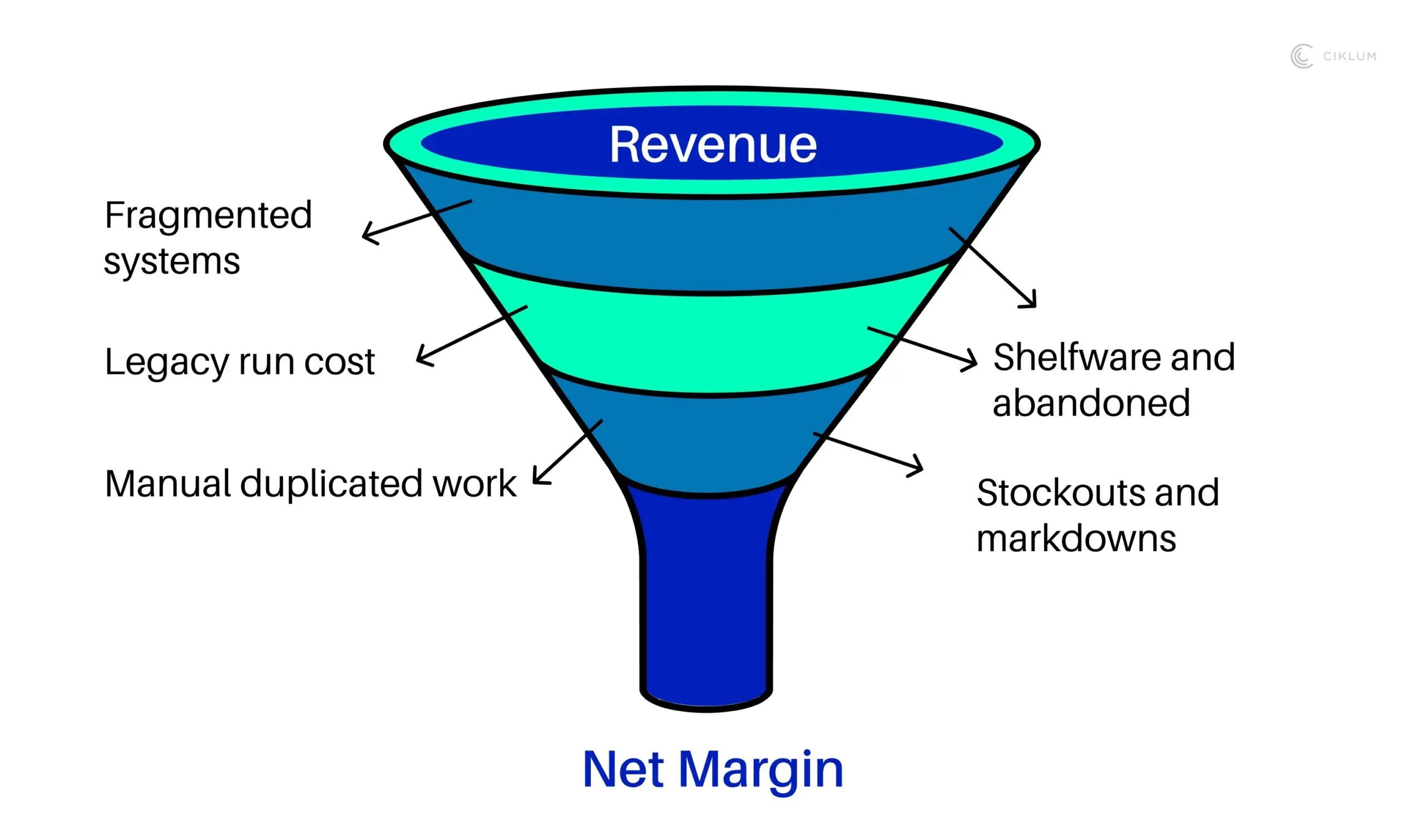
In a high-margin business, a wasteful system is an annoyance. In retail, it is a structural problem.
This is why the honest place to start is not "what should we buy" but "what is costing us more than it returns." The retailers that protect margin best are often not the ones with the most advanced customer-facing technology. They are the ones that found and stopped the leaks, because a dollar of recurring cost removed flows straight to margin, while a dollar of new revenue arrives carrying its own cost of goods, fulfillment, and overhead.
The drains also compound in a way the wins do not. A fragmented stack does not just cost what it costs today. It makes every future change more expensive, every new tool harder to integrate, and every data-driven decision less reliable. Left alone, the drain widens. That is what makes it the first thing worth fixing.
What Is Actually Draining Retail Margin
The specific leaks are consistent across retailers. They cluster in a few places, and almost none of them are the thing the business is currently worried about.
Fragmented Systems and the Integration Tax
Most retailers run on a patchwork of systems that were added one at a time, each solving a problem in isolation. The point-of-sale does not talk cleanly to e-commerce. Inventory lives in one place, orders in another, customer data in a third. Holding that patchwork together takes custom middleware that breaks whenever a vendor updates a release, and a team whose full-time job is reconciling data that should never have diverged. This integration tax is one of the largest hidden drains in retail, and it grows with every system added.
Legacy Systems That Cost a Fortune to Keep Alive
An aging core system rarely fails outright. It just gets more expensive to run every year. Specialist skills become rarer and pricier. Hardware needs replacing. Workarounds accumulate. And the real cost is not even the maintenance bill. It is the operating constraint the old system imposes on every store and every transaction, capping how fast the business can move and how cheaply it can serve customers. The longer the legacy system stays, the more it drains, both directly and in opportunity cost.
Manual Work That Technology Was Supposed to Remove
When systems do not connect, people fill the gap. Staff re-key orders that already exist somewhere else, reconcile inventory by hand, and manage exceptions caused by data that diverged between systems. This labor is invisible on the technology budget because it shows up as headcount, not software, but it is a direct consequence of the technology estate and it drains margin every shift. Automation that removes this duplicated work flows straight to operating margin.
Shelfware and Abandoned Projects
Retailers spend heavily on technology that never gets adopted. A platform bought and half-implemented. A tool licensed and barely used. A transformation program that stalled after go-live and quietly became "platform cost". This shelfware drains the budget twice, once in the original spend and again in the opportunity cost of the margin that investment was supposed to deliver and never did. It is one of the least discussed and most common drains in the industry.
Stockouts and Markdowns From Poor Visibility
When inventory data is fragmented and slow, the business cannot see what it has or where demand is going. The result is the most expensive kind of drain, lost sales from stockouts and margin given away in late, reactive markdowns on stock that sat in the wrong place. These are not abstract inefficiencies. They are recurring cash losses, and they trace directly back to a data and systems foundation that cannot support good decisions.
Why These Drains Stay Hidden
The common thread is that none of these drains appear on a dashboard labeled "margin loss". The integration tax hides inside maintenance budgets and headcount. Legacy run cost looks like a normal operating expense. Shelfware looks like a sunk cost nobody wants to revisit. Stockouts and markdowns get treated as the cost of doing retail rather than as a technology problem with a technology fix.
Meanwhile, the spending that does get attention is the visible, customer-facing kind, the new app, the personalization engine, the loyalty program. That spend is easier to celebrate and easier to fund, even when the operational foundation underneath it is the thing actually deciding the retail technology impact on margins. A retailer optimizing the storefront while the stockroom bleeds capital is investing in the half of the business that is easiest to see, not the half that is draining the most.

How to Turn It Around
Recovering margin from technology is less about buying something new and more about fixing what is already draining. The moves that turn it around show up on the P&L because they remove recurring costs rather than chasing uncertain revenue.
Consolidate the Stack and Cut the Integration Tax
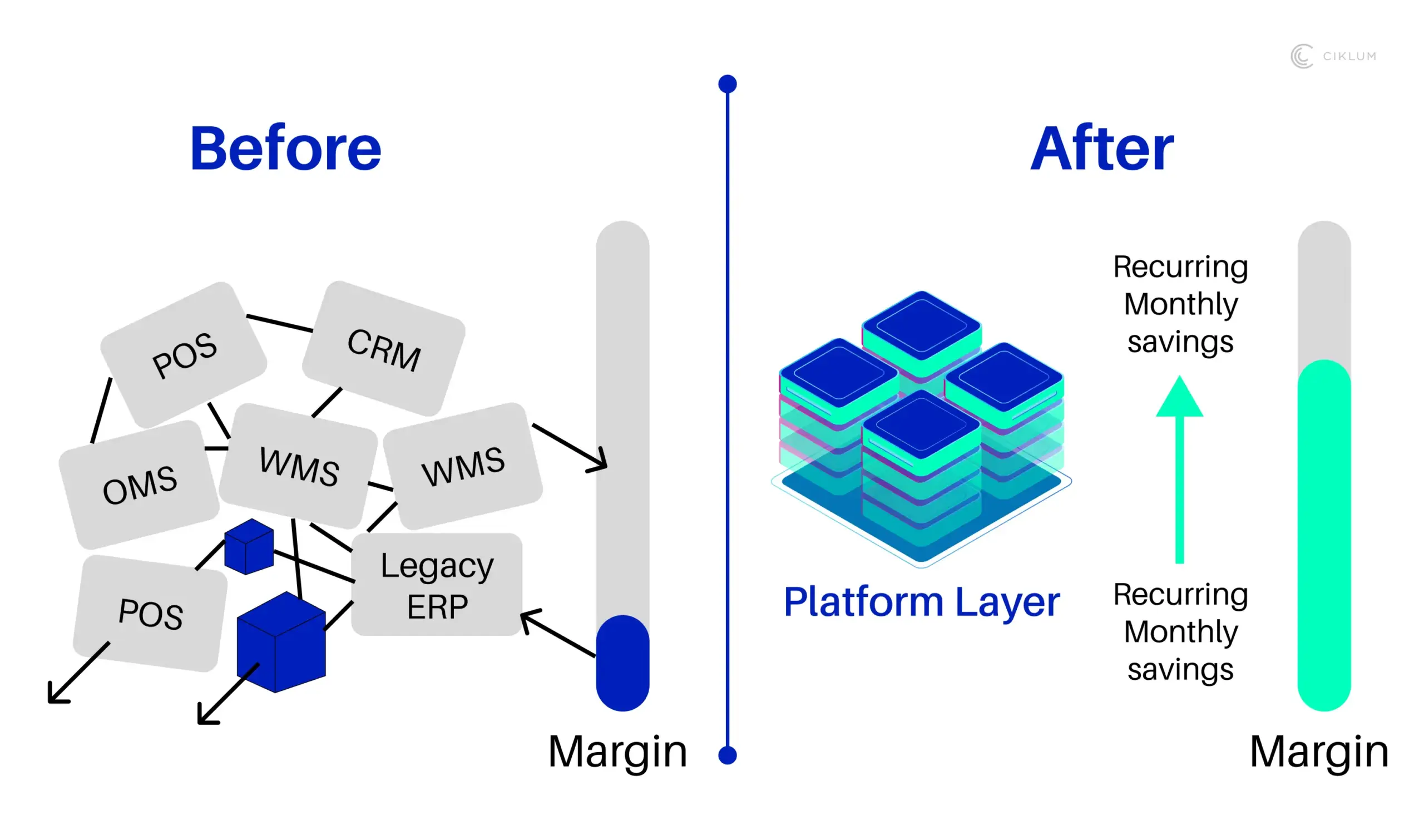
The highest-leverage turnaround is usually to reduce the number of systems and the custom glue between them. Moving toward a connected platform where inventory, orders, pricing, and customer data share one source of truth removes the reconciliation labor, the brittle middleware, and the integration tax that grows with every disconnected tool. One platform with one data model costs less to run, less to change, and less to govern than a dozen systems stitched together. The savings recur every month.
Modernize the Systems That Cost the Most to Run
Legacy systems that drain cost and constrain operations are worth modernizing first, not last. The incremental path works best, building the modern capability alongside the old system, moving a slice of traffic to it, and expanding until the legacy system can be retired, all while the business keeps running. Our legacy modernization practice favors this approach because it retires the run-cost drain without betting the business on a risky big-bang rewrite. The margin shows up in the quarters after, as both the maintenance bill and the operating constraint disappear.
Fix the Data Foundation So Decisions Stop Leaking Margin
Most of the operational drains, stockouts, markdowns, manual reconciliation, trace back to fragmented, slow data. Unifying that data into a real-time foundation is what makes good inventory and pricing decisions possible, which is what stops the recurring cash losses. Our data and analytics engineering practice works with retailers on exactly this layer, because no forecasting model or pricing tool can protect margin when the data underneath it is day-old and scattered across twenty systems.
Automate the Duplicated Work
Once systems connect, the manual labor that fills the gaps can be removed. Automating inventory checks, order handling, price updates, and exception management cuts the daily labor cost that fragmented systems quietly created, and that reduction flows directly to operating margin. The point is not to cut people for its own sake. It is to stop paying every shift for work the technology should have eliminated.
Sequence Spend to the P&L, Not the Keynote
The discipline that ties it all together is to fund the operational foundation before the customer-facing layer. Supply chain, inventory, pricing, and store platform first, because they protect margin that recurs every month. Personalization and customer-facing AI after, once the foundation can actually support them. This sequencing is what separates technology that compounds margin from technology that becomes next year's shelfware.
What the Turnaround Looks Like in Practice
When a retailer stops the drains and rebuilds the foundation, the margin recovery is structural rather than a one-off. The recurring costs fall and stay down. The data supports better decisions, so stockouts and markdowns shrink. The business can finally move at the pace customers expect without the old system fighting every change.
Ciklum's long-running work with Salling Group, Denmark's largest retailer running more than fifteen hundred stores across multiple brands, is a clear version of this. The work was not a single tool. It was rebuilding the e-commerce platform and the internal tooling underneath while keeping the chain running, with delivery teams folded into the group's own cadence. The reported outcome included a roughly forty percent reduction in technology costs alongside strong e-commerce growth and improved employee retention. That cost reduction is exactly the kind of recurring margin recovery that draining stacks make impossible and consolidated foundations make routine.
The same pattern shows up in store technology. A US footwear brand running an end-of-life point-of-sale system carried a visible hardware bill, but the deeper drain was the operating constraint the old system imposed on every store. Migrating to a modern cloud platform with mobile point-of-sale cut maintenance and hardware cost and let store operations move at the cadence customers expected. The margin showed up in the quarters after, as the operating model adapted to what the new platform allowed.
That is what turning it around actually means. Not another customer-facing tool layered on a leaking foundation, but a deliberate effort to find the drains, seal them, and rebuild the foundation so the next investment compounds instead of bleeding.
In Summary
In a two-to-five-percent margin business, the technology draining cost every month matters more than the next tool promising to lift revenue. The biggest drains, fragmented systems and their integration tax, costly legacy platforms, duplicated manual work, shelfware, and the stockouts and markdowns that flow from poor data, stay hidden precisely because none of them appear on a dashboard labeled margin loss.
Turning it around is foundational work. Consolidate the stack and cut the integration tax. Modernize the systems that cost the most to run. Fix the data foundation so decisions stop leaking margin. Automate the duplicated work. Sequence spent on the P&L rather than the keynote. Those moves recover margin that recurs every month, which is the durable version of improving the retail technology impact on margins.
Ciklum's retail and consumer engineering teams work with retailers to find the drains, modernize the foundation, and rebuild the data and platform layer that decides whether technology compounds margin or quietly erodes it. If margin is under pressure and the technology estate is part of the reason, talk to our specialists about turning it around.
Frequently Asked Questions
1. What technology is most often draining retail margin?
Usually the technology already in place rather than the technology still to buy. Fragmented systems create an integration tax and force manual reconciliation work. Legacy platforms cost more to run every year and constrain operations. Shelfware drains budget without delivering value. Poor data visibility causes recurring stockouts and markdowns. None of these appear as an obvious margin-loss line item, which is why they persist
2. Why does customer-facing technology often fail to improve margin?
Because revenue and margin are different lines. Personalization, apps, and loyalty programs can lift the top line while doing little for margin, and they often run on the same fragmented, day-old data that is causing the operational drains. Investing in the storefront while the supply chain and store platform leak capital optimizes the most visible part of the business rather than the most costly one.
3. How can a retailer find its hidden technology drains?
Look at recurring cost and recurring loss rather than at the project roadmap. Map the integration and maintenance spend holding the stack together, the run cost and constraints of legacy systems, the manual labor created by disconnected systems, the licensed tools that are barely used, and the stockouts and markdowns traced back to slow data. The drains live on operating expenses and lost sales, not in the next funding request.
4. What is the fastest way to recover retail margin from technology?
Cut recurring cost first, because it flows straight to the margin. Consolidating systems to remove the integration tax, modernizing the most expensive legacy platforms, and automating duplicated manual work all reduce cost that recurs every month. Fixing the data foundation then stops the recurring losses from stockouts and markdowns. Revenue-side investments come after the drains are sealed.
5. When should a retailer bring in external engineering support?
Two moments produce the highest return. The first is the assessment, where an outside view of the stack, the integration tax, and the legacy run cost surfaces drains the organization has stopped noticing. The second is the modernization and data-foundation work itself, where engineers with prior retail platform experience can consolidate systems and migrate off legacy without disrupting trading. Both need bandwidth that lean retail technology teams rarely have spare.

By Ciklum Editorial Team

Ciklum’s Editorial Board is a collective of experienced writers and industry experts, bringing together perspectives shaped by real-world engineering and delivery experience. Through collaborative insights, the team explores how technology, AI, and digital innovation move from concept to execution across industries.
Blogs
Discover Similar Insights

Why Digital Transformation in Payments Keeps Falling Short
Learn More
Why Your Product Releases Keep Slipping (and How to Fix It for Good)
Learn More
Scalability Starts Here: Architecture Decisions That Make or Break Your Product
Learn More
The Impact of Unified Commerce on Retail Growth and Efficiency
Learn More