



- Why Is Enterprise Modernization the Foundation for AI Success?
- What Does Modernizing Enterprise Technology Foundations Involve?
- How Is Software Engineering Changing in the AI Era?
- How Do Enterprises Operationalize AI Across the Business?
- How Does Enterprise Modernization Differ Across Industries?
- How Do You Build and Scale an Enterprise Modernization Strategy?
- The Takeaway
The biggest obstacle to enterprise AI isn't the model. It's the infrastructure beneath it.
Organizations are racing to deploy generative AI and AI agents, yet 70% to 90% of enterprise AI projects never move beyond the pilot stage. Why? Because legacy applications, fragmented data, technical debt, and outdated engineering practices weren't built for AI. The demo succeeds. Production doesn't.
The numbers tell the story. 81% of executives say technical debt is already limiting their AI ambitions. The challenge isn't building smarter AI. It's building an AI-ready enterprise.
That's where enterprise modernization becomes a strategic imperative. Modernization is no longer just about migrating to the cloud or replacing legacy systems. It's about creating an AI-ready foundation with modern applications, cloud-native architecture, unified data platforms, API-first integration, automated operations, and engineering practices that allow AI to scale securely and deliver measurable business value.
In 2026, the defining challenge for enterprise leaders isn't whether to adopt AI. It's how to modernize the business so AI can actually succeed.
This guide provides a practical roadmap for enterprise AI modernization, outlining what to modernize first, how to prioritize investments, and how to measure success across applications, data, cloud, engineering, operations, and organizational readiness.
Why Is Enterprise Modernization the Foundation for AI Success?
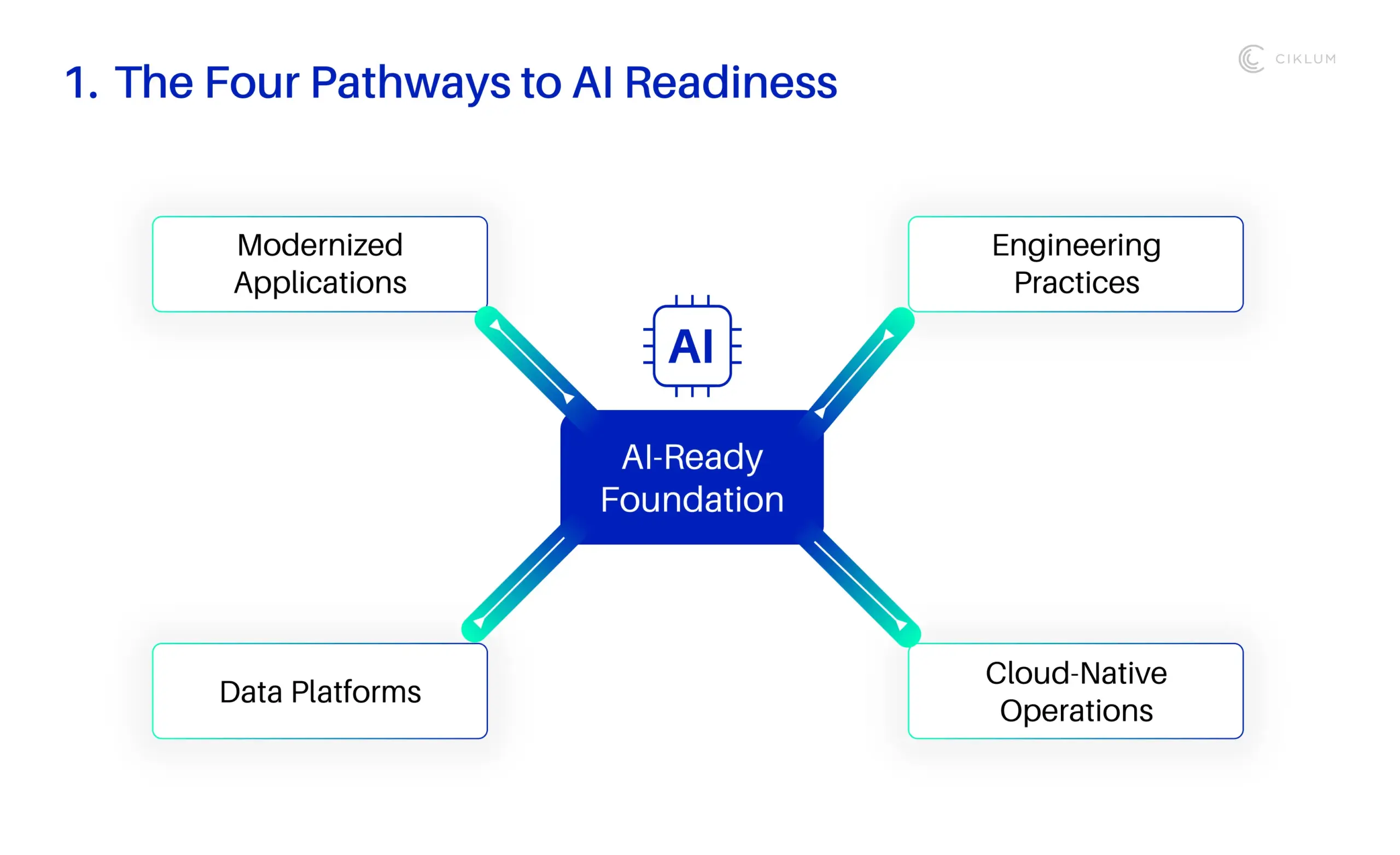
Enterprise modernization is the foundation of AI readiness. Without modern applications, trusted data, and scalable AI infrastructure, even the most advanced AI models struggle to deliver business value.
Enterprise AI is only as effective as the systems that support it. When AI is powered by clean, governed, and well-integrated data, it enables better decisions, automation, and measurable business outcomes. But when it relies on fragmented data, legacy systems, and outdated infrastructure, it amplifies existing inefficiencies, producing inaccurate insights and limiting AI adoption.
AI doesn't fix technical debt or modernize legacy technology. It exposes every weakness in your enterprise architecture. That's why enterprise modernization, including application modernization, data modernization, cloud transformation, and API-first integration, is the critical first step in any successful AI transformation strategy.
Why Enterprise Modernization Is Now a Boardroom Priority
Modernization used to be an infrastructure line item. It is now a strategic priority driven by four forces:
- Customer expectations for real-time, personalized experiences
- Operational efficiency in a cost-conscious market
- Pressure to innovate faster than competitors
- Resilience against outages, breaches, and regulatory failures
AI has raised the stakes on all four, because none of them can be addressed with AI unless the underlying systems are ready.
The financial argument is now impossible to ignore at board level. Deloitte's 2026 Global Technology Leadership Study estimates that technical debt consumes 21% to 40% of enterprise IT spending every year. IBM's research goes further, finding that enterprises which fully account for technical debt in their AI business cases project 29% higher ROI than those that ignore it, while ignoring it produces an ROI decline of 18% to 29%. AI is finally forcing technical debt onto the C-suite agenda, and the numbers are not comfortable.
The Real Cost of Legacy Applications and Technical Debt
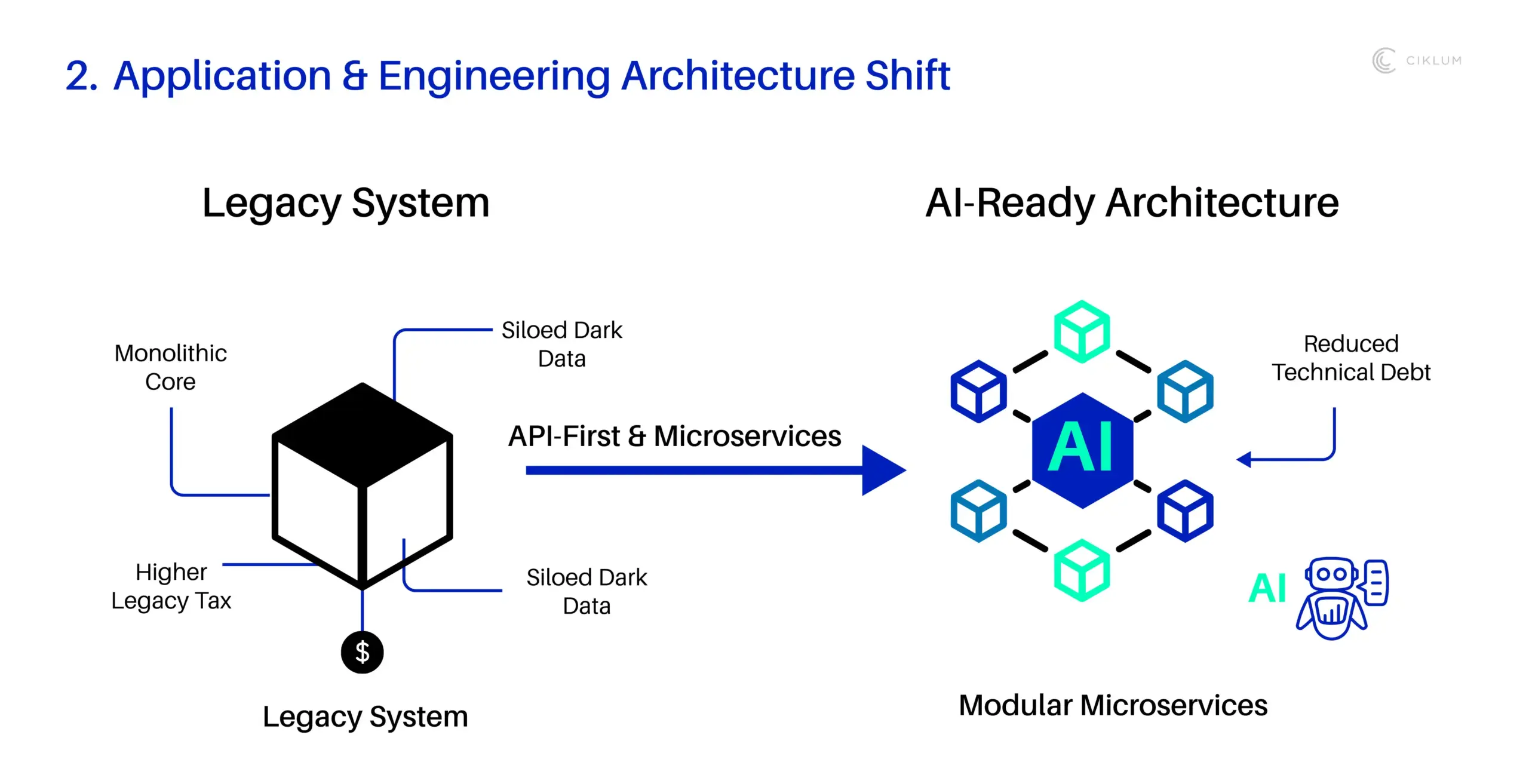
Legacy systems are expensive in ways that rarely sit in a single ledger. Maintaining aging systems quietly consumes the budget, engineering time, and talent that AI initiatives need, which is why legacy modernization belongs on the roadmap before any agentic AI does. The true cost hides in integration workarounds, end-of-life vendor contracts, and security remediation rather than a single line item, so it is easy to underestimate and it compounds the longer it is deferred. Every innovation initiative pays a legacy tax before it starts, and every agentic AI deployment that touches a legacy core amplifies that tax rather than removing it.
Disconnected systems add a second cost. When data is trapped in silos and applications cannot talk to each other without brittle point-to-point integrations, the organization cannot get a single view of a customer, a transaction, or a risk. That fragmentation is the single biggest blocker to AI, because a model reasoning over incomplete or stale data produces confident, unreliable answers.
How Modernization, Digital Transformation, and AI Transformation Fit Together
Digital transformation changed how enterprises engage customers and run processes. AI transformation is the next layer, embedding intelligence into those processes. Modernization is the foundation that makes the second layer possible on top of the first. The common barriers are familiar:
- The perceived risk of touching business-critical systems
- The shortage of engineers who understand both legacy and modern stacks
- Unclear ROI
- Organizational inertia
The enterprises that overcome these challenges do so by treating modernization as an incremental, continuously funded discipline rather than a single high-risk rewrite, which is the principle we build every modernization program around.
What Does Modernizing Enterprise Technology Foundations Involve?
Modernizing the foundation means addressing three layers together: applications, cloud and platform, and data. Treated separately they produce local wins that do not compound. Treated together they create a scalable, secure, AI-ready enterprise.
Application Modernization With API-First Design and Microservices
Application modernization moves monolithic, tightly coupled systems toward modern architectures built on API-first design and, where the rate of change justifies it, microservices. The goal is not to decompose everything. It is to place seams where fast-changing parts of the system are trapped behind slow-changing ones, and to expose capabilities through clean APIs so new services and AI agents can consume them without rebuilding what already exists. Application integration strategy matters as much as the architecture itself, because most enterprise value is unlocked by connecting systems that were never designed to talk.
The discipline here is restraint. API-first design and modular boundaries pay off. Speculative distributed complexity does not. The right architecture is the smallest one that removes the specific bottleneck the business is actually paying for.
Cloud and Platform Modernization for AI-Ready Infrastructure
Cloud and platform modernization provides the elastic, automated infrastructure that AI workloads demand. That includes cloud migration strategy, hybrid and multi-cloud environments for flexibility and resilience, platform engineering to give developers self-service access to reliable infrastructure, infrastructure automation to eliminate manual toil, and DevSecOps so security is embedded in the pipeline rather than inspected at the end. Modernized, cloud-native systems are also measurably more resilient. On DORA metrics, they deliver 40% fewer failures and recover five times faster than the brittle legacy estates they replace.
Data Modernization and AI-Ready Data Ecosystems
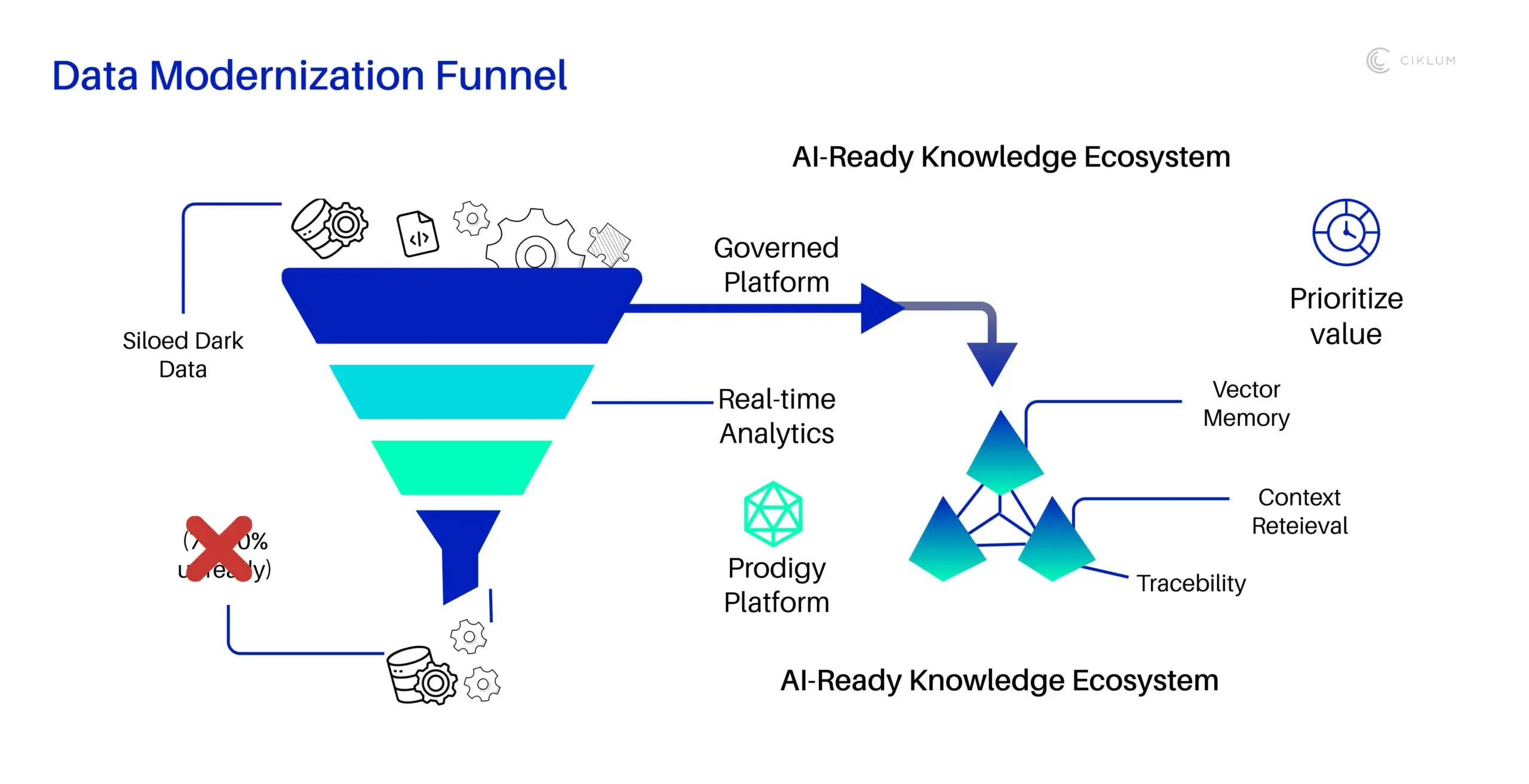
Data is the layer most enterprises underestimate, and in our modernization work it is consistently the decisive one for AI. The single hardest truth we see is simple: you cannot run meaningful generative AI or agentic workflows on siloed, dark data, no matter how capable the model. Data modernization means building enterprise data platforms with real data quality and governance, adopting modern data architecture that supports real-time analytics, and creating AI-ready data ecosystems where information is clean, cataloged, accessible, and traceable.
The proof shows up in the numbers. At Salling Group, Denmark's largest retailer, rebuilding the platform underneath the business cut technology costs by 40% alongside exponential e-commerce growth, because the data layer, the workflow, and the operating model moved together rather than as isolated projects. The pilots that stall are almost always the ones that met fragmented production data the model was never going to survive.
How Is Software Engineering Changing in the AI Era?
Software engineering is shifting from writing code to orchestrating and governing AI-assisted delivery across the entire lifecycle. The engineer's role is moving toward that of a conductor who directs AI agents, validates their output, and owns the architecture and quality that AI cannot be trusted to guarantee on its own.
The AI-Enabled Software Development Lifecycle
AI now contributes to every phase of the software development lifecycle, not just code generation. The larger shift is systemic rather than a coding speed-up: agent-driven practices interpret requirements, analyze dependencies, suggest architectures, generate tests, and self-optimize across the pipeline. AI-enabled engineering embeds that intelligence from backlog generation through logic checks and test data creation, which is how engineering cycles get faster without getting sloppier.
Platform Engineering, Product Engineering, and Quality at Speed
Speed without discipline manufactures new debt, and AI-generated code makes this risk acute because it can carry higher security and maintainability risk than human-written code. Four practices keep AI-accelerated delivery safe:
- Platform engineering improves developer experience and standardizes the paved road so teams ship on reliable rails.
- Product engineering keeps delivery anchored to business outcomes rather than sheer output volume.
- Intelligent testing and quality engineering use AI to expand coverage and catch edge cases early, which is exactly what makes fast refactoring of legacy systems safe.
- DevSecOps and continuous delivery tie it together, so security and release velocity move as one rather than trading off against each other.
Two engagements make the point. At Bytes, a UK and Ireland software reseller, the right architectural seams and a modern delivery platform took release cycles from twice a year to every two weeks. In healthcare, AI-enabled engineering only stuck once it was run as a change-management effort owned by internal teams rather than a tools rollout, which is the line between real adoption and expensive shelfware.
How Do Enterprises Operationalize AI Across the Business?
Operationalizing AI means moving from isolated pilots to governed, enterprise-wide systems, and that requires architecture rather than enthusiasm. Gartner predicts that 40% of enterprise applications will include task-specific AI agents by the end of 2026, up from less than 5%, yet only a small fraction of organizations have actually deployed agents at scale. The distance between those two numbers is where modernization pays off or fails to.
From Generative AI to Agentic Automation
Enterprise generative AI, AI agents, and intelligent workflow automation all sit on a common enterprise AI automation stack: a workflow engine to act, a reasoning layer to decide, vector memory for context, and an orchestration layer for safety and governance. The highest-return early use cases are knowledge-heavy processes such as audit, compliance, document review, and regulatory reporting, where generative AI can automate the reading and interpretation while humans keep judgment. The distinction that matters is that agents coordinate other tools toward outcomes and are not simply a replacement for every bot or chatbot.
Governance, Responsible AI, and Human-in-the-Loop
The reason so many agentic projects stall is governance, not capability. AI-powered decision support and autonomous workflows carry real consequences, so enterprise AI governance, responsible AI practices, auditability, and human-in-the-loop controls have to be designed in from the start. "Better outcomes from AI require systems that can retain deep institutional memory and customer context over time," said Gartner analyst Andrew Brocklehurst in the firm's analysis of agentic AI's $234 billion disruption of enterprise software. That institutional memory is precisely what a governed knowledge layer provides, and it is why we built the Knowledge Engine into our PRODIGY platform with source traceability and workflow context built in.
Scaling AI Adoption Across Business Functions
Once the foundation and governance exist, AI adoption spreads across finance, customer service, HR, operations, and software engineering, because the same data and orchestration layer serves all of them. The enterprises seeing returns are not chasing use cases at random. They identify a specific bottleneck, map the interpretation steps, build a governed pipeline around that one workflow, and then reuse the foundation for the next. Build the foundation once, apply it many times, and the cost of each new capability drops.
How Does Enterprise Modernization Differ Across Industries?
The principles of modernization are constant, but the priorities and constraints vary by sector. What stays the same everywhere is the sequence: fix the data and platform foundation first, then apply AI where it compounds.
Healthcare: Healthcare leads with clinical systems modernization, interoperability across fragmented record systems, and digital patient experiences, all under strict auditability and compliance constraints. AI-enabled healthcare operations are advancing fastest in administrative and clinical workflow automation, with AI agents rewiring how care organizations operate by automating claims, onboarding, and compliance so staff can focus on patients.
BFSI: Banking, financial services, and insurance prioritize core banking modernization, risk and compliance transformation, fraud detection, and customer experience modernization, all under heavy regulation. The winning pattern treats compliance, fraud, and CX as layers on one shared data and integration foundation rather than three separate stacks, which is where the leverage in financial services modernization actually sits.
Retail: Retail focuses on unified commerce, intelligent supply chains, customer personalization, and operations modernization, in a business where net margins are thin and the operational layer decides profitability. The pressure is pushing retailers from static, reactive dashboards toward AI-powered insights that enable prescriptive, real-time decisioning.
Hi-Tech: Technology and SaaS companies concentrate on product engineering, platform modernization, AI-enabled software delivery, and engineering productivity, because their product is the software itself and delivery speed is a competitive weapon. This sector also faces the sharpest version of the agentic disruption, as buyers increasingly want measurable outcomes rather than more dashboards and seats.
What unites all four is that the differentiation no longer comes from the technology a sector adopts, but from the discipline with which it modernizes the foundation and sequences AI on top. A retailer with a real-time data platform and a bank with a shared compliance-and-fraud foundation are playing the same game as a SaaS firm with an AI-native delivery pipeline. They have each decided to fix the foundation before scaling the intelligence.
How Do You Build and Scale an Enterprise Modernization Strategy?
You build and scale a modernization strategy by treating it as a continuous portfolio rather than a one-off project, aligning every initiative to a measurable business outcome, and funding it as an ongoing investment.
Building an Enterprise Modernization Roadmap
A practical roadmap starts by assessing current technology maturity honestly, including the true, often-hidden cost of legacy systems. From there, prioritize the initiatives with the clearest link to business outcomes, align technology objectives with business objectives so funding survives budget cycles, and develop an explicit AI adoption strategy that the modernization work is designed to enable. Scaling across the enterprise then becomes a matter of reusing the same foundation, patterns, and governance rather than reinventing them for each department.
Governance and Change Management
Modernization fails more often on organizational grounds than technical ones. Executive sponsorship keeps the program funded through the inevitable slow quarters. Organizational readiness and change management determine whether new practices take root or get abandoned. Risk management keeps business-critical systems safe during transition, which is why incremental patterns that keep systems in production throughout beat big-bang rewrites. The recurring lesson from real engagements is that adoption is a people problem as much as a platform one.
Measuring Modernization Success and ROI
Measure modernization in outcomes, not project completion. Track engineering productivity metrics, operational efficiency, customer experience improvements, AI adoption rates, and ultimately business value and ROI. The financial evidence favors treating modernization as continuous investment rather than a one-off cost. Best practice, in the end, is continuous modernization backed by enterprise governance and the long-term capability to keep innovating at scale.
The Takeaway
The industry keeps framing 2026 as the year to buy more AI. That is the wrong instruction. Worldwide AI spending is on track to reach $2.59 trillion this year, according to Gartner, and a large share of it will be wasted, not because the models are weak, but because they are being layered onto foundations that cannot hold them. The underrated move is to spend less on net-new AI features and more on the unglamorous foundation that decides whether any of them survive contact with production.
Every enterprise that layers agents onto a legacy core is paying a legacy tax before its AI even starts, and that tax compounds every year until modernization becomes unavoidable anyway. The organizations that pull ahead will not be the ones with the most models or the biggest AI budgets. They will be the ones disciplined enough to modernize applications, engineering, data, and operations first, then let AI compound on top of a foundation built to carry it.
That is the reframe that matters. In the AI era, modernization is not the thing you do instead of AI transformation, and it is not a prerequisite you rush through to get to the interesting part. Modernization is AI transformation. The enterprises that internalize that will spend the next decade compounding. The ones that do not will spend it firefighting.
If your AI initiatives are stalling somewhere between pilot and production, the constraint is almost certainly the foundation beneath them, not the model on top. Talk to our modernization and AI engineering teams about which layer is closest to paying for itself.
Frequently Asked Questions
Q1: What is enterprise modernization in the AI era?
Enterprise modernization in the AI era is the process of transforming applications, engineering practices, data platforms, cloud infrastructure, and operations into modern, cloud-native, API-driven, AI-ready foundations. The distinguishing feature in the AI era is that modernization is no longer just about reducing cost or risk. It is about creating the conditions in which AI can be adopted at scale and deliver measurable business value, because AI workloads fail on fragmented data and brittle legacy systems.
Q2: Why do so many enterprise AI projects fail?
Most enterprise AI projects fail for foundational reasons, not model reasons. Between 70% and 90% never reach production, and the primary causes are poor data readiness, legacy integration barriers, and technical debt rather than the capability of the AI itself. Only about a third of enterprise data is AI-ready, and technical debt already consumes 21% to 40% of IT budgets, so AI initiatives inherit those weaknesses the moment they touch real systems.
Q3: Should we modernize before adopting AI, or at the same time?
In practice the two run together, but the data foundation has to lead. The most effective pattern is to identify a high-value business bottleneck, modernize the specific data and application layer that workflow depends on, and deploy AI against that clean foundation, then reuse the foundation for the next use case. This avoids both the paralysis of a multi-year "modernize everything first" program and the failure mode of layering AI onto systems that cannot support it.
Q4: How is AI changing legacy modernization itself?
AI is compressing the cost and timeline of modernization dramatically. Gartner projects that 90% of software modernization will use AI-augmented tools by 2029, up from less than 15% today, with generative AI halving modernization labor costs. AI now assists with automated code translation, dependency mapping of undocumented legacy estates, and test generation that makes refactoring safe, turning modernization from a manual, high-risk effort into a faster, evidence-driven one.
Q5: How do you measure the ROI of enterprise modernization?
Measure it in business outcomes rather than project milestones: engineering productivity, operational efficiency, customer experience, AI adoption, resilience metrics such as failure rate and recovery time, and total cost of ownership. The strongest financial signal is that deliberate modernizers, who allocate at least a third of their technology budget to change, run around 20% lower operating costs and innovate faster, and enterprises that account for technical debt in their AI business cases project up to 29% higher ROI.
Q6: What are the biggest barriers to enterprise modernization, and how do organizations overcome them?
The biggest barriers are the perceived risk of changing business-critical systems, the shortage of engineers fluent in both legacy and modern stacks, unclear or contested ROI, and organizational inertia. Organizations overcome them by modernizing incrementally rather than through big-bang rewrites, keeping systems in production throughout the transition, using AI-augmented tooling to map dependencies and reduce migration risk, and securing executive sponsorship so the program is funded as a continuous investment rather than a one-time project. Framing modernization around a specific, measurable business bottleneck is what turns an abstract, easily-deferred initiative into one the business will actually back.
By Ciklum Editorial Team

Ciklum’s Editorial Board is a collective of experienced writers and industry experts, bringing together perspectives shaped by real-world engineering and delivery experience. Through collaborative insights, the team explores how technology, AI, and digital innovation move from concept to execution across industries.
Blogs
Discover Similar Insights

The AI-Accelerated Platform: How AI Is Changing Legacy Modernisation and Platform Scaling
Learn More
Inside PRODIGY: The Knowledge Engine Behind Enterprise AI
Explore How the Knowledge Engine Works
The Agentic Shift: Rewiring the Retail Operating Model
Learn More
Beyond Cost Savings: The Real Value of AI Automation for Enterprises
Explore the Full ROI Case